DeepIP vs Solve Intelligence: A Practical Comparison of AI Patent Drafting, Review & Prosecution Tools (2026)

AI has become a standard part of patent work. The question in 2026 is no longer whether a tool can generate claims, but whether it fits the way patent professionals actually operate—drafting in Microsoft Word, working from prior art and patent prosecution history, and producing work product that holds up under scrutiny.
DeepIP and Solve Intelligence are often shortlisted together because both apply generative AI to patent drafting and prosecution, yet they are built around different priorities.
DeepIP emphasizes end-to-end workflow coverage, Word-native drafting, grounded review, and strong support for complex domains such as chemistry and life sciences. On the other hand, Solve Intelligence is best known for a streamlined browser-based drafting experience and a more automated approach to patent figure generation.
The differences between the two become clear when you look at how each platform supports the different stages of the patent lifecycle in real workflows: drafting, review, prosecution, figures, and day-to-day adoption.
DeepIP vs Solve: Comparison Deep-Dive by Workflow Step
1. Invention Harvesting, Disclosure, & Early Novelty Assessment
Many downstream patent risks are determined before drafting begins, making invention harvesting and early novelty assessment critical to how effectively AI can be used later in the process.
DeepIP
DeepIP supports invention harvesting and novelty assessment as an explicit starting point in the patent workflow. The platform helps structure invention disclosure early, guiding inventors and patent professionals through the information needed to assess novelty and scope before drafting begins.
DeepIP supports:
- Structured invention disclosure workflows to capture technical detail consistently
- Guided questions to help clarify inventive concepts and distinguish them from prior art
- Early novelty and patentability, and competitive analysis signals that inform drafting strategy
- A smoother handoff from disclosure to search, analysis, and drafting
This approach helps reduce late-stage rework by identifying scope and risk earlier in the process.
Solve Intelligence
Solve Intelligence does not position invention harvesting or invention disclosure as a core workflow. In practice, it assumes that inventions are already sufficiently defined before drafting or prosecution begins.
As a result, Solve is typically used after invention capture and early novelty assessment have been handled through other tools or processes.
Practical Difference
DeepIP extends AI support into invention capture and early novelty assessment, while Solve focuses primarily on drafting and prosecution once an invention is already formalized.
2. Drafting: Applications & Claims
Once an invention is clearly captured and scoped, the quality of AI-assisted patent drafting depends on how well the tool supports structure, context, and control—rather than just text generation.
DeepIP
DeepIP represents a deliberate shift in how AI is applied to patent drafting. By embedding natively in Microsoft Word, the platform integrates AI into established drafting practices—preserving templates, styles, and jurisdiction-specific requirements—while supporting deep customization and complex technical domains, so teams can improve speed and quality without retooling their workflows or retraining around a new interface.
DeepIP supports:
- Full application drafting with strong customization (structure, style, templates)
- Domain and jurisdiction sensitivity, including high-complexity fields such as chemistry and life sciences
- Drafting that connects to review and prosecution workflows, rather than treating drafting as a one-off “generate text” step
- Increasing consistency as practitioner preferences and drafting standards are applied over time
Solve Intelligence
Solve Intelligence is often chosen for a clean, browser-based drafting flow that feels fast for early drafts and quick iterations. Teams evaluating Solve typically like how quickly they can generate, edit, and refine a draft in a focused environment.
Solve tends to work best when:
- Your team prefers browser-first drafting over Word-native workflows
- Speed and simplicity matter more than deep workflow integration
Practical Difference
DeepIP is optimized for drafting within an integrated workflow and Word environment; Solve is optimized for fast drafting cycles in a streamlined browser UI.
3. Review & Analysis: Patentability, Quality Checks, & Proofreading
AI-generated drafts only become usable work products after rigorous review, where patentability, clarity, and support must be evaluated before issues surface in prosecution.
DeepIP
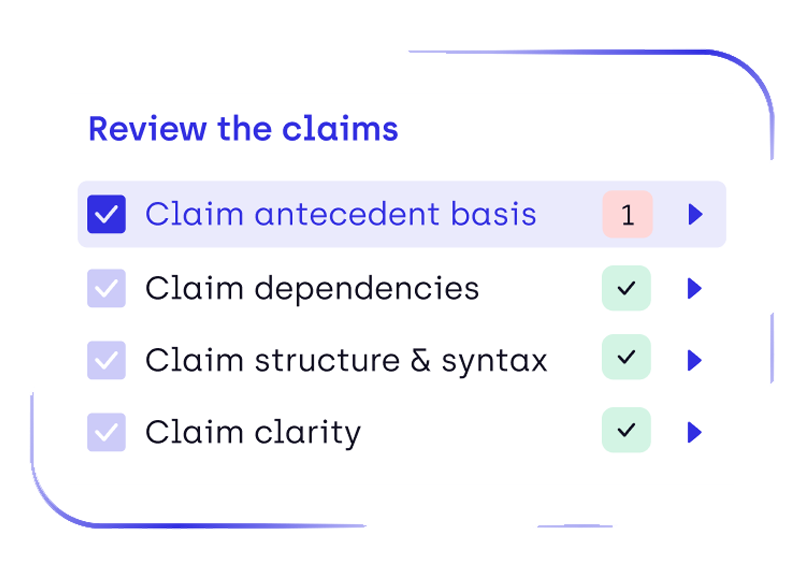
DeepIP treats review as a dedicated step—not just “rewrite this paragraph,” but a structured way to spot risk before filing or responding. This is especially valuable when teams want consistent quality control across many applications.
DeepIP supports:
- Patentability-oriented review (novelty and risk signals, not only language polishing)
- Patent draft proofreading and examiner-style logic to surface clarity, support, and potential weaknesses
- More defensible output via grounded analysis and citations (e.g., prosecution history and legal references)
- A review experience close to the drafting surface (reducing context loss and manual back-and-forth)
Solve Intelligence
Solve can help improve quality through strong drafting and rewriting assistance, particularly for practitioners who already know what they want to argue and need help iterating language efficiently.
Solve’s value here is strongest when:
- Review happens mainly through drafting iteration and refinement
- The team doesn’t require a distinct, structured “review layer” in the workflow
Practical Difference
DeepIP emphasizes structured, grounded review; Solve emphasizes speed of rewriting and drafting iteration.
4. Claim Charts & Claim-To-Disclosure Mapping
Claim charts sit at the intersection of analysis and prosecution, and an AI tool’s ability to map claims accurately to disclosure or prior art can directly influence response strategy, amendment decisions, and overall defensibility.
DeepIP
DeepIP approaches claim charts as part of a broader analysis and prosecution workflow, rather than as a standalone output. Claim-to-disclosure and claim-to-prior-art mapping are designed to support examiner-style review and office action responses, not just document generation.
DeepIP supports:
- AI-assisted claim mapping grounded in application content and prosecution context
- Use of claim analysis to inform review, response strategy, and amendment decisions
- Integration of claim mapping into drafting and prosecution workflows, rather than exporting isolated charts
- A focus on defensibility and consistency, especially when claim charts are reused across prosecution stages
This makes claim charts more actionable in practice, particularly when they are used to support arguments rather than simply document positions.
Solve Intelligence
Solve Intelligence is well known for its claim charting capabilities, which are often highlighted as a core strength. The platform enables fast generation of claim charts and structured mappings, making it attractive for users who frequently need standalone claim charts for analysis or response preparation.
Solve’s approach works particularly well when:
- Claim charts are a primary deliverable rather than part of a broader workflow
- Speed of claim chart generation is a key requirement
Practical Difference
Solve Intelligence emphasizes claim chart generation as a distinct capability, while DeepIP integrates claim mapping into a continuous drafting, review, and prosecution process.
5. Patent Search & Intelligence: Prior Art & Research
Effective patent drafting and review rely on prior art context, and the way an AI tool surfaces, interprets, and carries search results forward can directly affect claim scope and prosecution outcomes.
DeepIP
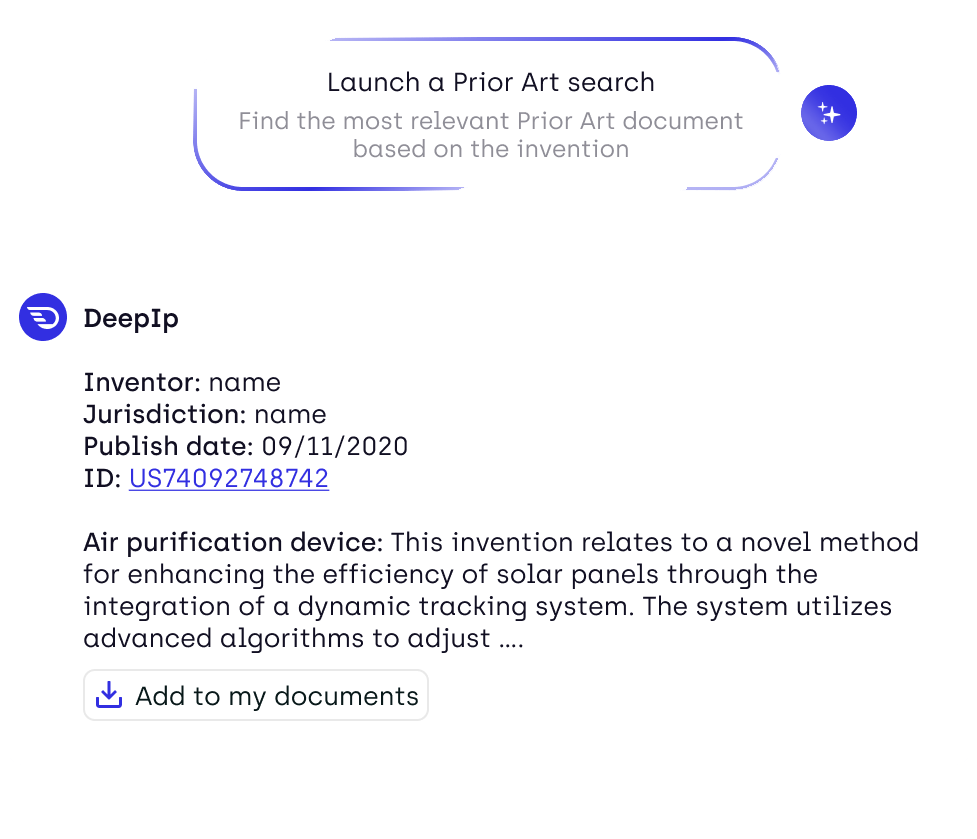
DeepIP is built to connect search outputs to decisions, because the best drafting and prosecution outcomes usually depend on what you find before you write. Instead of treating research as separate, DeepIP is designed to carry context forward into analysis and drafting.
DeepIP supports:
- Semantic and agentic-style search designed to feed patentability and drafting decisions
- Retrieval workflows aligned with how practitioners investigate novelty and scope
- A tighter “search → analyze → draft” loop that reduces tool switching and missed context
Solve Intelligence
Solve Intelligence is not typically positioned as a primary prior art search or patent intelligence platform. Teams using Solve often conduct prior art search and landscape analysis in dedicated tools, then rely on Solve primarily for drafting and amendment workflows.
Solve’s approach works best when:
- Prior art search and patent intelligence are handled outside the drafting tool
- Known references are already identified before drafting or prosecution begins
- The primary value of AI is accelerating drafting and amendments rather than discovery
Practical Difference
DeepIP is designed to make search actionable inside the drafting/review workflow; Solve is generally used after search has already been completed in other tools.
6. Patent Prosecution: Office Actions & Response Drafting
During patent prosecution, the reliability of AI support is tested under real scrutiny. Office action responses must align with file history, cited art, and examiner reasoning, and small inconsistencies can carry long-term consequences.
DeepIP
DeepIP’s prosecution workflow is designed for environments where responses must be not only fast, but defensible, consistent, and reviewable over time. Office action responses are supported through a dedicated module that connects to drafting and review context, helping maintain consistency across the file history.
DeepIP supports:
- Collaborative and customizable drafting and review for office action responses
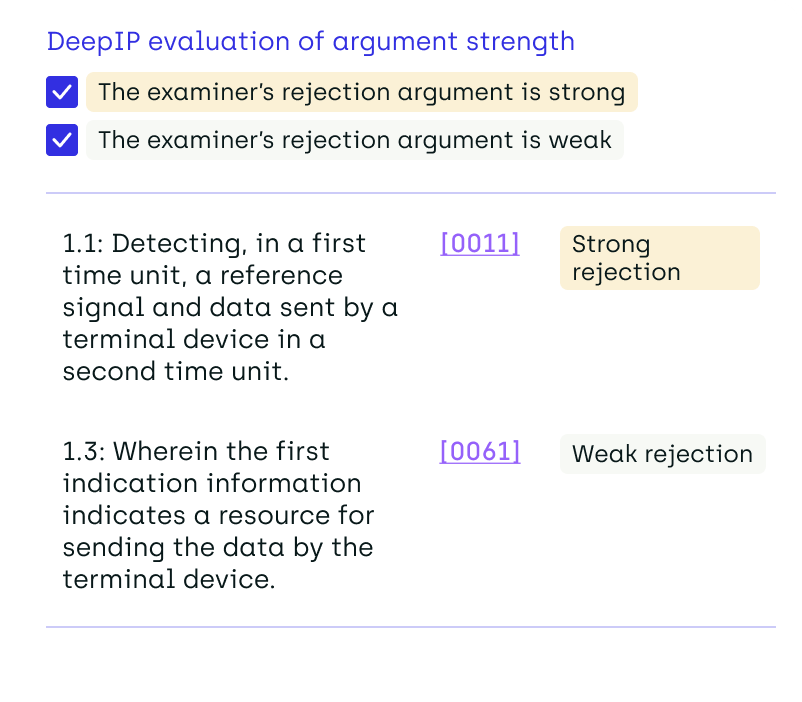
- AI suggestions grounded in prosecution context and prior filings, rather than generic response language
- Multi-source citation workflows (e.g., wrapper history and legal references), supporting auditability and internal review
- Greater consistency across responses, helping reduce contradiction and downstream risk
This approach is particularly valuable where prosecution work is reviewed by multiple stakeholders or expected to hold up under future scrutiny.
Solve Intelligence
Solve Intelligence can be effective at accelerating the drafting of amendments and response language, particularly when practitioners already have a clear strategy and want to iterate quickly on text.
Solve’s approach works best when:
- The prosecution strategy is already defined by the practitioner
- The primary need is rapid drafting and rewriting of response language
- Office action cycles are treated as discrete drafting tasks rather than part of a broader continuity strategy
Practical Difference
DeepIP emphasizes prosecution workflows that prioritize grounding, reviewability, and consistency across the file history. Solve Intelligence emphasizes speed and iteration in response drafting, with less focus on prosecution continuity and auditability.
7. Patent Drawings & Figures: Sketch Generation & Management
Patent drawing generation is not merely a formality, and AI tools that mishandle figures or labels can introduce inconsistencies that undermine claim interpretation and disclosure quality.
DeepIP
DeepIP treats patent drawings as part of the core drafting workflow, keeping figures aligned with the evolving specification, claims, and terminology as applications change. By generating drawings in context, the platform helps reduce inconsistencies between figures and written disclosures over time.
DeepIP’s figures workflow is best understood as:
- Context-aware figure generation aligned with claims and specification
- Integrated directly into drafting and review workflows
- AI drawing models trained for industry-specific requirements, including life sciences and chemistry
Solve Intelligence
Solve Intelligence offers a dedicated drawings workflow that emphasizes automation and standalone figure handling. The platform supports common figure-management tasks used during drafting and prosecution preparation.
Solve’s drawings workflow includes:
- Support for multi-figure uploads
- Label tracking and consistency checks
- Detection of missing labels
- Export-ready figure outputs
Practical Difference
DeepIP emphasizes drawings as part of the integrated application workflow; Solve emphasizes drawings automation as a dedicated pipeline.
8. Continuations, Portfolio Strategy, & Litigation Readiness
After an application is filed, patent work shifts from document production to strategic decision-making. Continuation choices, portfolio pruning, competitive positioning, and enforcement risk are all shaped by how consistently assets have been drafted, prosecuted, and analyzed over time.
DeepIP
DeepIP is designed to support portfolio-level decision-making alongside prosecution and post-grant risk assessment. By combining grounded drafting and review with portfolio intelligence and landscape analysis, the platform helps teams evaluate not just individual patents, but how families and portfolios perform in context.
DeepIP supports:
- Continuity across parent, continuation, and divisional filings through consistent drafting and prosecution records
- Portfolio-level intelligence to assess asset strength, coverage gaps, and pruning opportunities
- Patent landscape analysis to understand competitive positioning, white space, and risk exposure
- Dedicated freedom to operate (FTO) and invalidity analysis modules supporting enforcement preparation and defensive strategy
- Outputs that remain reviewable, explainable, and usable across legal, business, and strategic stakeholders
This makes the platform particularly relevant for teams managing active portfolios that must be optimized, defended, extended, or challenged over time.
Solve Intelligence
Solve Intelligence is primarily optimized for drafting and prosecution efficiency during active filing cycles, rather than portfolio strategy or competitive landscape analysis.
Solve’s approach works best when:
- Portfolio management and landscape analysis are handled in separate tools
- Continuation, pruning, and competitive strategy decisions are made outside the drafting environment
- The primary objective is efficient drafting and amendment during prosecution
Practical Difference
DeepIP integrates continuation strategy, portfolio intelligence, landscape analysis, and post-grant risk assessment into the broader patent workflow. Solve Intelligence emphasizes drafting and prosecution efficiency, with portfolio and competitive analysis typically addressed elsewhere.
8. Workflow Integration: Microsoft Word, Templates, Governance, & IPMS Fit
Even strong AI capabilities can fail in practice if they disrupt established drafting environments. For most patent teams, workflow integration and governance are decisive factors in whether an AI tool is adopted broadly or remains peripheral.
DeepIP
DeepIP was intentionally built to integrate into the workflows patent professionals already use, rather than requiring teams to adapt to a new operating model. Its Word-native architecture and workflow controls are designed to minimize friction while maintaining consistency, oversight, and scalability.
DeepIP supports:
- Native use inside Microsoft Word, allowing drafting, review, and editing in the primary authoring environment
- Full preservation of templates, styles, and firm or jurisdiction-specific conventions
- Governance and workflow controls aligned with enterprise and firm requirements
- Full integration and compatibility with broader systems, including IPMS environments and browser-based environments
This approach makes it easier for teams to introduce AI without disrupting established processes or compromising document integrity.
Solve Intelligence
Solve Intelligence uses a browser-first drafting environment, which can be appealing for simplicity and focused drafting sessions. For teams with standardized Word-based templates and document workflows, however, this model often requires switching between tools and adjusting established processes.
Solve’s approach works best when:
- Teams are comfortable operating primarily in a browser-based drafting environment
- Templates and formatting standards are less central to the workflow
- Drafting speed is prioritized over deep integration with existing systems
Practical Difference
DeepIP is designed to fit seamlessly into Word-based, template-driven workflows with governance and system integration in mind, while also offering integration into IPMS or browser-based environments. Solve Intelligence is designed around a browser-first drafting model that emphasizes simplicity and speed.
9. Chemistry & Life Sciences: Domain-Specific Support
In highly technical domains such as chemistry and life sciences, AI patent tools must handle structured data and regulatory requirements accurately, or risk creating technically invalid disclosures.
DeepIP
DeepIP is built with deep verticalization for domains where patent work involves structured data, regulatory constraints, and technical artifacts that generic drafting tools struggle to handle. This is particularly important in chemistry and life sciences, where sequences, chemical structures, experimental data, and formal compliance requirements directly affect patentability, prosecution strategy, and long-term defensibility.
DeepIP supports:
- Sequence listings and ST.26 outputs
- Chemistry-friendly drafting workflows (including structured elements)
- Markush-style claim complexity and supporting artifacts
- Handling of tables and experimental data
Solve Intelligence
Solve Intelligence takes a more domain-agnostic approach to AI-assisted patent drafting, applying the same core drafting workflows across a wide range of technical fields rather than deeply specializing in specific industries.
Solve’s approach works best when:
- Drafting assistance is needed across diverse technical domains
- Domain-specific artifacts (e.g., sequence listings, structured chemistry data) are handled outside the drafting tool
- Flexibility and general-purpose drafting matter more than industry-specific depth
Practical Difference
DeepIP is optimized for complex domain workflows; Solve is optimized for general drafting efficiency.
10. Adoption & Usability: Onboarding & Time-to-Value
Ultimately, the impact of any AI patent tool depends on how quickly practitioners can adopt it and use it consistently without compromising legal standards or workflow efficiency.
DeepIP
DeepIP is designed to integrate into existing drafting and review workflows, allowing teams to adopt AI support without a full workflow redesign. In practice, this often results in shorter onboarding periods and earlier operational use compared with tools that require a new drafting environment.
DeepIP is typically associated with:
- Faster time-to-value (weeks)
- Minimal disruption for no matter where you work, especially for Word-based teams
- Broader usability across mixed experience levels
- A reliability-oriented workflow (review, grounding, citations when relevant)
Solve Intelligence
Solve tends to reward teams who invest time into learning a power-user tool. Once mastered, it can be very fast for drafting-centric workflows—but it often requires a longer ramp-up.
Solve is typically associated with:
- A longer onboarding period (often months) to reach full proficiency
- Strong performance for practitioners who value speed inside a browser drafting environment
Practical Difference
DeepIP prioritizes rapid adoption across teams; Solve prioritizes speed and simplicity within a browser-first drafting approach.
FAQ: DeepIP vs Solve Intelligence

What is Solve Intelligence used for?
Solve Intelligence is commonly used to speed up patent drafting and amendment work in a browser-based environment. It’s often evaluated by practitioners who want fast first drafts and quick iteration on claim and response language.
What is DeepIP used for?
DeepIP is used across multiple steps of patent work, including drafting in Word, structured review, prosecution support, and integrated search/intelligence workflows—especially in environments that value grounded output and workflow continuity.
Which is better for drafting patent applications?
If your drafting process relies on Word templates, established styles, and document-based collaboration, DeepIP typically fits more naturally. If you want a streamlined browser drafting flow for quick generation and iteration, Solve is often attractive.
Which platform is better for patent review and proofreading?
DeepIP is generally stronger for teams that want a distinct review layer with examiner-style checks and grounded analysis. Solve can improve quality through iterative drafting and rewriting, especially when experienced practitioners drive the reasoning.
Does Solve Intelligence include prior art search?
Solve is not usually positioned as a primary prior art search or patent intelligence tool. Many teams run search elsewhere and use Solve mainly for drafting and amendments.
Does DeepIP include AI patent search?
Yes. DeepIP supports semantic and agentic-style search designed to feed patentability review and drafting decisions, helping teams carry context forward into downstream work.
Which is better for office actions and prosecution workflows?
DeepIP is typically better suited for teams that want collaborative, grounded office action response workflows and citations tied to the file history. Solve is often effective for accelerating drafting of amendments and response language, particularly for text-heavy cycles.
Which is better for patent drawings?
Solve is often viewed as more automated for drawings today (uploads, label checks, export readiness). DeepIP integrates drawings into the broader drafting workflow to keep figures aligned with specification and claim strategy as the application evolves.
Which is easier to adopt?
DeepIP is designed for faster team-wide adoption, especially for Word-based organizations. Solve often requires a longer ramp for teams to reach full proficiency, but can be very fast for users who invest in learning it.
Is DeepIP only for enterprise or corporate IP teams?
No. While DeepIP is designed to scale for complex workflows, it can also be used by law firms and individual practitioners who want Word-native drafting plus review/prosecution support.
Is Solve Intelligence only for law firms?
Not necessarily. Solve is commonly used in law-firm drafting environments, but any patent practitioner who prefers a browser-first drafting workflow may find it useful.
What should I prioritize when comparing AI patent tools?
Most teams get the clearest decision by focusing on (1) where drafting happens (Word vs browser), (2) whether review is grounded and auditable, (3) how prosecution support handles file history and citations, (4) how drawings are managed, and (5) the realistic time to adoption.
.png)