Agentic Patent Search: How Autonomous AI Helps Corporate IP Teams
.png)

The volume of prior art companies must analyze is compounding faster than legal teams can staff.
More than 3.7 million patent applications are filed globally every year, according to WIPO’s IP Statistics Data Center, with chemistry, biotech, and software leading growth. Search queries are more complex, more interdisciplinary, and harder to scope.
This is why agentic patent search—AI that autonomously explores, iterates, and reasons about potential prior art—has emerged as a turning point.
Unlike traditional keyword or semantic search, agentic systems perform multi-step reasoning loops that mimic (and accelerate) the strategic thinking of an experienced analyst.
For corporate IP teams, this shift isn’t just about speed. It’s about raising recall, reducing bias, and delivering more defensible search outputs. Early adopters report faster review cycles as agentic workflows take over the most repetitive parts of the job.
These efficiency gains align with broader enterprise AI research: McKinsey estimates that GenAI could automate activities that account for 60–70% of employees’ working hours across many knowledge-based occupations.
Let’s dive into what agentic patent search is, how it works across industry-specific, corporate IP workflows, and why autonomous AI is changing patent processes before the claim even hits the page.
The Prior Art Bottleneck: Why Traditional Search No Longer Scales
Patent search has never been more demanding—nor more strategically consequential. As corporate IP teams handle larger portfolios with smaller budgets, the complexity of prior art search has become an operational bottleneck.
Three industry forces are driving the shift:
1. Volume and velocity continue to rise
Global patenting activity has exceeded pre-pandemic levels. WIPO reports steady annual increases in PCT filings, including strong growth in pharmaceuticals, medical technologies, and digital communications. This expansion compounds search complexity for corporations managing global portfolios.
2. Inventions are more interdisciplinary
Most new filings in life sciences, chemistry, and advanced engineering cross traditional discipline boundaries:
- Small molecules with AI-designed scaffolds
- CRISPR constructs using computational protein engineering
- Materials inventions integrating chemistry, physics, and simulation
- Software-enabled devices blending embedded systems, ML, and signal processing
Traditional Boolean search often breaks in the face of these hybrid embodiments.
3. Human-driven search is time- and recall-limited
Analysts must:
- Engineer the right queries
- Iterate dozens of times
- Review hundreds—sometimes thousands—of documents
- Extract claim-limiting features
- Summarize relevance
Across corporate IP teams, patentability or invalidity searches can easily consume up to 20 hours or more each. With portfolios expanding, workloads bottleneck long before drafting or strategy even begins.
Agentic AI changes that equation.
What Is Agentic Patent Search? Definition, Examples, and How It Works
Agentic patent search is an AI-driven approach that autonomously iterates through multiple search and reasoning steps—expanding the search scope, evaluating equivalents, and producing traceable evidence chains without manual query tuning.
An agentic patent search system behaves like a junior analyst who:
- Explores the space beyond the user's initial assumptions
- Builds hypotheses about potential equivalents or alternative embodiments
- Runs new searches to validate or refute those hypotheses
- Surfaces the most relevant hits with traceable evidence
- Summarizes insights in a structured, legally meaningful way
Why does agentic search outperform semantic search?
By contrast, most traditional AI patent search tools rely on semantic similarity. These systems embed the query into a vector space and retrieve documents with the closest linguistic or structural match.
Semantic search improves over keyword search, but it remains a single-step retrieval method: it does not reformulate queries, test alternative interpretations, or reason about functional equivalents. The result is useful similarity ranking—but not the kind of iterative, hypothesis-driven exploration an agentic system performs.
This framework echoes broader findings in AI research: multi-step and multi-agent reasoning consistently improves task performance. Studies on chain-of-thought prompting show that intermediate reasoning steps boost accuracy on complex tasks. DeepMind’s research on multi-agent learning further confirms the benefits of iterative, collaborative reasoning loops.
How Agentic AI Cuts Prior Art Search Time: Multi-Step Workflows Explained
1. Autonomous Query Reformulation
In a traditional workflow, analysts spend large amounts of time crafting and refining queries—especially in chemistry and biotech. Agentic systems do this automatically, evaluating edge cases a human may not consider.
2. Larger Search Space Exploration
Agentic AI can analyze structural variants, functional homologs, algorithmic equivalents, and cross-classification art. The system expands beyond the inventor’s framing, mitigating “tunnel vision” that often affects human analysts.
3. Automated Relevance Ranking
Instead of manually assessing hundreds of hits, reviewers can focus on the top 10–20 highest-scoring candidates—each accompanied by an explanation of why the AI selected it.
4. Evidence Chains and Auditability
Because the reasoning chain is captured, agentic search outputs are more defensible in prosecution or litigation contexts. Repeatability—critical for §102/§103 analyses—becomes far easier.
Agentic Patent Search Use Cases in Chemistry, Biotech, and Software
Chemistry & Materials Science
Chemical prior art is notoriously difficult. Markush claims cover millions of possible compounds, similarity can be functional, not literal, and equivalent structures may appear across unrelated subclasses
Bringing in agentic systems can:
- Expand a submitted structure into families of variants
- Test functional equivalents (e.g., similar binding characteristics or catalytic behavior)
- Search patents and scientific literature
- Identify cross-domain hits (e.g., a catalyst paper informing a pharma intermediate)
Researchers have long shown that chemical substructure and maximum common substructure (MCS) search are computationally intensive, with exact matching classified as NP-complete. More recent work confirms that scaling substructure search to large databases remains challenging.
These constraints make chemical structure analysis a natural candidate for more advanced, iterative AI-assisted search workflows.
Biotech & Life Sciences
Biotech searches often require:
- Sequence similarity analysis
- Functional annotations
- Homology and domain matching
- Mapping from gene/protein families to delivery mechanisms
An agentic system may start with a CRISPR construct, expand to nuclease variants, then check delivery vectors across patents and PubMed—all without user prompting.
This mirrors best practices in homology searching outlined by the NCBI and the Broad Institute.
Software, AI, and Emerging Technologies
Software inventions require:
- Identifying algorithmic equivalents
- Searching across open-source repositories
- Understanding embeddings, models, or architectural patterns
In software, AI, and emerging technology domains, agentic systems can move well beyond keyword matching by identifying architectural analogues and functional equivalents across disparate technical fields. They merge insights from patents, arXiv preprints, and even code repositories to build a more complete view of how an invention fits within existing work.
In doing so, agentic search can surface cross-domain collisions that are easy to miss—for example, when a machine-learning compression method overlaps with signal-processing techniques in telecommunications.
Why Agentic Search Produces More Defensible Outputs—not Just Faster Ones
1. Reducing Human Query Bias
Research in information retrieval has long shown that query formulation strongly influences what documents are retrieved, with small changes in phrasing leading to meaningfully different results.
Agentic search reduces this risk by automatically testing alternative interpretations and expanding the query space to ensure broader coverage.
2. Transparent Evidence Chains
Every search expansion, retrieved document, and relevance rationale is captured. This is vital for §102/§103 analysis, litigation support, FTO risk documentation, and cross-jurisdictional filings.
3. Repeatability
Because workflows can be rerun, organizations can demonstrate consistent methodology—a growing expectation as both USPTO and EPO issue AI-related guidance.
How Agentic AI Integrates Into Modern IP Workflows
Patentability & Early-Stage Search
Teams can run autonomous searches at ideation to identify novelty risks before drafting even begins. Agentic search becomes an extension of the R&D funnel.
Invalidity & FTO Search
By exploring adjacent classes and interpreting claims broadly, agentic systems reduce the risk of missing relevant prior art. Analysts remain in control, but the AI accelerates the path to defensible insights.
Competitive & Portfolio Intelligence
Agentic workflows can automatically monitor competitors, detect shifts in filing themes, and surface emerging risks or white spaces.
This moves IP organizations closer to continuous surveillance rather than episodic portfolio management analysis.
What an Agentic Search Looks Like in Practice
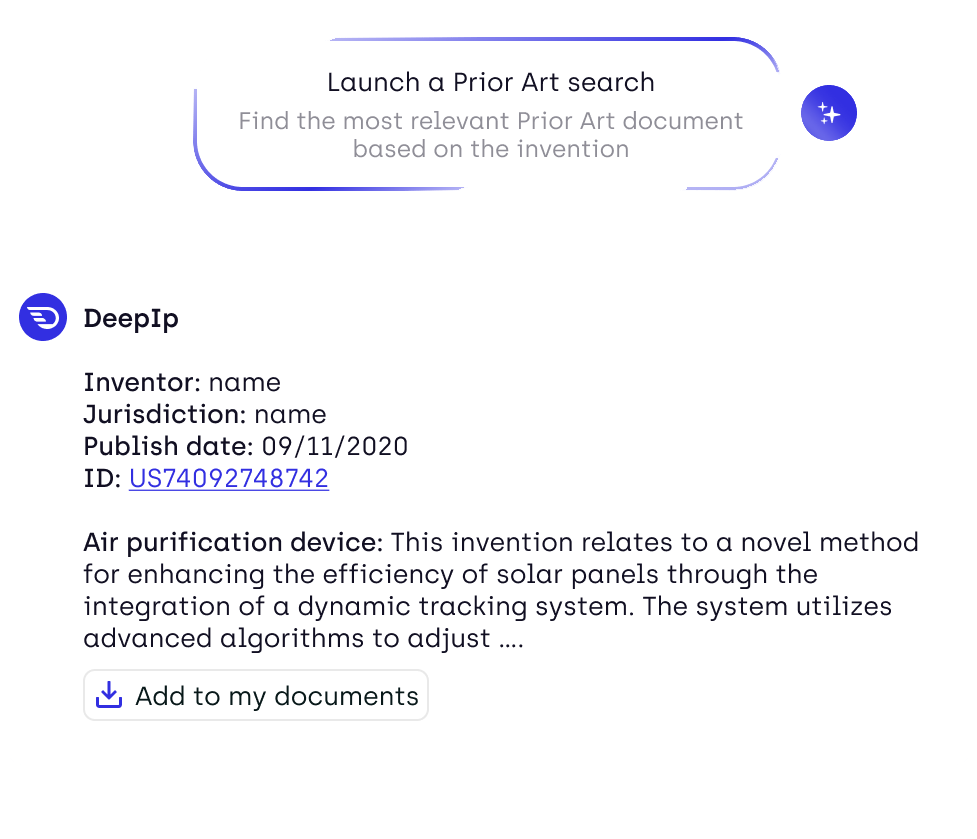
In a typical corporate IP setting, an agentic search in DeepIP begins when an in-house counsel or R&D-linked patent strategist needs rapid clarity on the novelty or risk profile of a new invention—often before drafting begins or when preparing an FTO assessment under tight timelines.
Instead of issuing a single semantic query, the user initiates an agentic search, prompting the system to explore the invention from multiple angles: structural, functional, and cross-domain.
The AI behaves like a tireless junior analyst, probing alternative interpretations, testing edge cases, and drawing connections across diverse data sources to surface the most defensible prior art landscape.
On DeepIP’s platform, an agentic search workflow typically functions as follows:
- User enters a description, claim, structure, or sequence
- AI extracts the invention’s core elements
- System autonomously runs a series of search iterations, reformulating queries and testing alternative interpretations
- Chemical or biological structures are expanded into equivalents and substructures
- Cross-domain searches (e.g. patents, scientific literature, code repositories) run in parallel
- AI ranks the most relevant hits, explaining why each matters
- A defensibility pack is generated, enabling attorneys to evaluate risks efficiently
DeepIP utilizes this capability as part of its Agentic Search, Patentability, FTO/Invalidity, and Portfolio Intelligence suites—built specifically for corporate IP teams, law firms, and innovation-intensive industries.
Responsible Use and Limitations
Even the most advanced agentic systems do not replace legal judgment. Practitioners remain responsible for final relevance assessments, legal interpretation of claims, and ensuring completeness of search strategies.
This aligns with USPTO and EPO guidance around AI use during prosecution.
As agentic systems become more capable, the distinction between experimental tools and enterprise-ready platforms becomes increasingly important.
High-quality systems must also ensure:
- Transparent reasoning
- Evidence traceability
- Hallucination mitigation
- Clear data provenance
Together, these capabilities define whether an AI system can truly support the rigor and reliability required in corporate IP environments.
What Corporate IP Teams Should Do Next
Corporate IP leaders adopting agentic search generally follow a three-step roadmap:
- Pilot agentic workflows on active projects (e.g. patentability or invalidity cases)
- Integrate insights into drafting and review to reduce cycle times
- Establish defensibility frameworks leveraging AI reasoning chains for consistent documentation
As many early adopters report, the shift is less about replacing analysts—and more about empowering them to handle rising workloads with greater rigor and strategic impact.
.png)