
Invalidity search & charts, made smarter.
Surface stronger prior art and build defensible combinations in a fraction of the time.









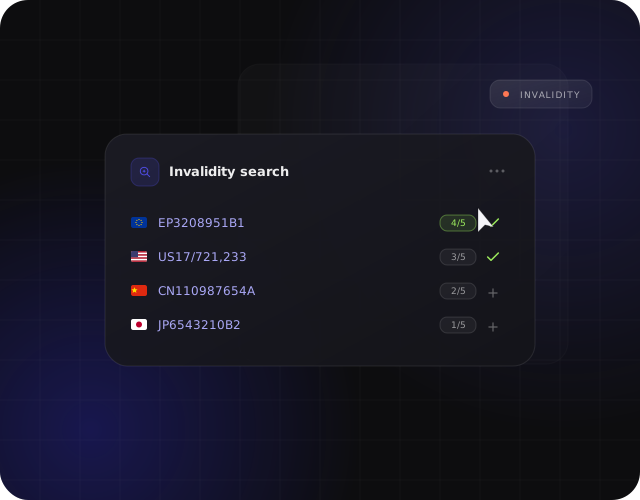
prior art search
Surface high-value prior art in hours, not weeks.
Leave the manual database trawling behind.
- Automate retrieval across global patent and non-patent literature databases
- Map product or claim features directly to relevant prior art text
- Identify anticipatory references and compelling combinations faster and more defensibly
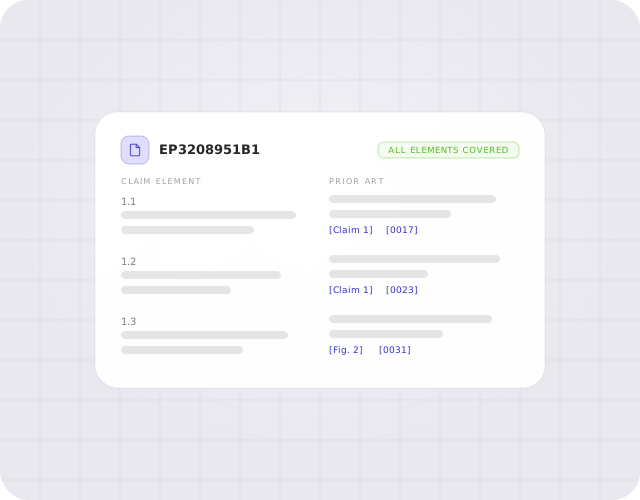
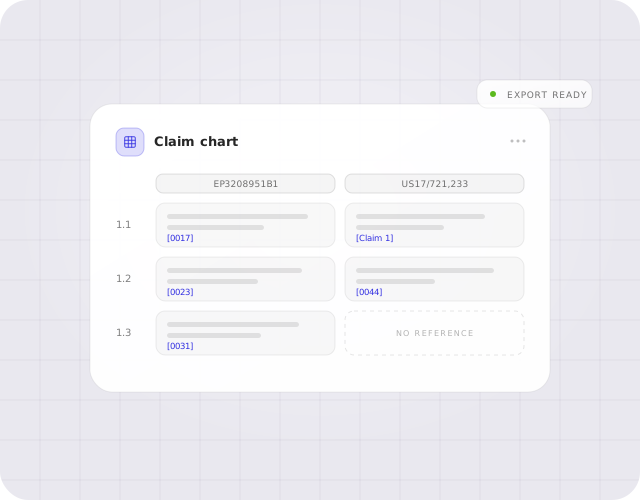
claim charting
Spend time on strategy, not claim charts.
Cover more ground in less time, with fewer blind spots.
- Surface high-value prior art across patents and non-patent literature automatically
- Generate claim charts that focus your attention on the evidence that matters
- Move from prior art to finished chart in a fraction of the time
invalidity analysis
Every conclusion tied to its source.
Know exactly how every invalidity argument was built and why it holds up.
- Connect every invalidity conclusion to the underlying prior art text
- Maintain full visibility into how combinations were identified and scored
- Deliver results that are consistent, traceable, and ready to defend
word integration
Invalidity opinions, drafted where you already work.
No new tools to learn, no exports, no disruption.
- Draft your full invalidity opinion directly inside Microsoft Word
- Benefit from higher adoption and usage versus web-based platforms
- Keep your team aligned in the tool they already use
Enterprise-grade security.
Your patent data is protected by the highest industry standards. Deployed on Microsoft Azure with end-to-end encryption.


Microsoft Word
Draft and review patents directly within your familiar Word environment.

Outlook
Manage office action deadlines
and receive AI-powered response suggestions.
Docketing systems
Seamless integration with leading IP management platforms.
REST API
Build custom integrations with a comprehensive, well-documented API.
Go deeper.
.png)
.png)
Questions & answers.

What is an invalidity search and why is it important in patent litigation?
An invalidity search identifies prior art that can be used to challenge the validity of a patent’s claims under §102 (anticipation) or §103 (obviousness). Strong invalidity grounds rely on finding relevant prior art, connecting it to specific claim limitations, and building persuasive combinations with clear motivation to combine. This process helps litigators, in-house teams, and patent professionals weaken or invalidate patents during disputes, PTAB proceedings, or licensing negotiations.
How does DeepIP support building stronger obviousness combinations and “motivation to combine”?
DeepIP automatically generates potential §103 combinations by aligning claim features with evidence from multiple references. The platform scores each combination and surfaces the strongest linkages, providing context that helps practitioners articulate motivation-to-combine arguments. This dramatically reduces the time spent manually crafting combos and strengthens the overall validity challenge strategy.
How can in-house patent teams use DeepIP to strengthen their legal strategy in disputes or licensing negotiations?
Corporate IP teams often lack the time or bandwidth to conduct deep invalidity research when facing litigation threats or negotiating licenses. DeepIP enables them to quickly uncover strong prior art, evaluate invalidity positions internally, and engage external counsel with a clearer strategy. This reduces reliance on outside firms, accelerates decision-making, and gives in-house teams more control during high-stakes situations.
How do large IP law firms and litigation teams use DeepIP to improve their invalidity workflows?
Large firms managing complex matters benefit from DeepIP’s ability to streamline prior art discovery, combo generation, and chronology building. By automating tedious research steps and providing transparent evidence mapping, the platform helps distributed teams deliver faster, more consistent invalidity analyses—improving profitability on fixed-fee work and enabling litigators to focus on argumentation rather than document triage.
Can smaller IP firms or solo practitioners rely on AI tools for accurate invalidity analysis?
Absolutely. DeepIP’s transparent evidence links, feature-to-text mapping, and defensible scoring ensure that smaller practices can confidently use AI to accelerate their invalidity work without compromising quality. Solo practitioners and boutique firms can cover more ground in less time, produce stronger invalidity grounds, and increase capacity without hiring additional staff.
The go-to platform for IP practitioners.
Join the IP teams already working this way who have transformed their workflows with AI-powered patent intelligence.
