
Draft biology patents from sequences and experimental data with AI trained for biological innovation.










Biology Patent AI
Built for real biology practice.
DeepIP helps patent teams draft biology applications from sequences and experimental data with less manual reconciliation, safer reuse of sequence context, and fewer cross-reference errors.
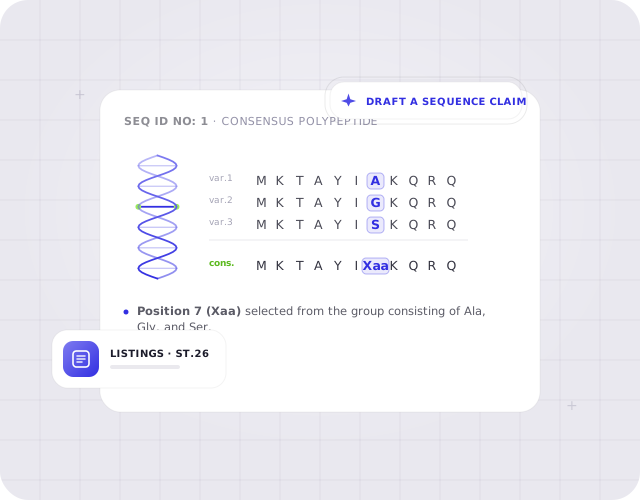
Sequences become structured drafting context.
DeepIP turns uploaded sequences into structured drafting context, preserving identifiers, qualifiers, and key annotations so they remain reusable throughout the application. Late additions, renumbering, and downstream references stay easier to manage across claims and description.
Maintain ST.26 without manual re-entry.
DeepIP helps maintain ST.26-compliant sequence listings as drafting evolves, reducing the manual burden of edits, modified residues, and export preparation.
Consensus sequence with human control.
DeepIP helps generate an ST.26-compliant consensus sequence from selected sequence inputs, lets you add it directly to your sequence listing, and keeps it available as structured context for downstream drafting.
Consistent boilerplate for sequence-heavy drafting.
Sequence identity thresholds, antibody language, and repeated biology paragraphs create hours of low-value work. DeepIP helps generate and reuse them consistently so the draft stays coherent as it grows.
Enterprise-grade security.
Your patent data is protected by the highest industry standards. Deployed on Microsoft Azure with end-to-end encryption.


Microsoft Word
Draft and review patents directly within your familiar Word environment.

Outlook
Manage office action deadlines
and receive AI-powered response suggestions.
Docketing systems
Seamless integration with leading IP management platforms.
REST API
Build custom integrations with a comprehensive, well-documented API.
Go deeper.
Questions & answers.

What is biology patent drafting?
Biology patent drafting involves preparing patent applications for biological inventions such as proteins, antibodies, nucleic acids, and other biomolecules. These applications often include sequence listings, experimental data, and detailed descriptions of biological function. Because biological inventions rely heavily on sequence information, drafting requires careful alignment between the sequence listing and the written specification.
What is an ST.26 sequence listing?
ST.26 is the international standard for sequence listings used in patent applications involving nucleotide or amino acid sequences. It defines how sequences, identifiers, qualifiers, and annotations must be formatted and submitted to patent offices. Proper ST.26 compliance is essential for applications filed with major patent offices worldwide.
How does DeepIP help with biology patent drafting?
DeepIP helps patent teams draft biology applications directly from sequence data and experimental materials. It turns sequences into structured drafting context so identifiers, annotations, and references remain consistent across the application. This reduces manual reconciliation and helps avoid cross-reference errors between the sequence listing and the specification.
Can DeepIP maintain ST.26 sequence listings during drafting?
Yes. DeepIP helps maintain ST.26-compliant sequence listings as drafting evolves. This reduces the manual work involved in updating sequences, handling modified residues, and preparing compliant exports for filing.
Can DeepIP generate consensus sequences?
DeepIP can help generate an ST.26-compliant consensus sequence from selected sequence inputs. The consensus sequence can be added to the sequence listing and used as structured context throughout the drafting process.
How does DeepIP reduce errors in sequence-heavy patent applications?
Sequence-heavy patents often contain many references between sequence listings, claims, and descriptions. DeepIP keeps sequence identifiers, annotations, and references structured and reusable throughout drafting. This helps reduce cross-reference errors and improves internal consistency across the application.
Can DeepIP work with existing sequence data and disclosures?
Yes. DeepIP can ingest sequences, technical disclosures, prior drafts, and experimental data. Once uploaded, sequences become structured context that can be referenced consistently throughout the patent application.
The go-to platform for IP practitioners.
Join the IP teams already working this way who have transformed their workflows with AI-powered patent intelligence.