AI Patent Drafting Tools in 2026: Can They Handle Chemistry & Biotech?

In 2026, AI patent drafting systems are no longer experimental—especially for chemical and life science portfolios. Corporate IP teams—especially in chemicals, biotech, and pharma—use them daily to manage rising filing volume and shrinking drafting budgets. One study shows that all IP professionals surveyed were using AI for up to 50% of their work time.
But the central question for these sectors remains unresolved: Can an AI patent drafting tool truly handle chemistry-heavy inventions without introducing structural risk?
Given the precision required for molecules, sequences, and Markush structures, “almost right” can still mean legally catastrophic.
Why Chemistry Pushes AI to Its Breaking Point
Most drafting failures aren’t linguistic—they’re structural. Chemistry demands determinism, not probabilistic text generation.
Recent research confirms that molecular-generation AI is still far from infallible. A 2024 study found that many SMILES strings output by chemical language models are invalid—meaning they cannot be translated into any real chemical structure. A 2025 review warns that, despite advances, molecular validity remains a persistent challenge, particularly when models are used without chemical constraints.
The same risks—incorrect connectivity, invalid valences, implausible scaffolds—directly translate when AI is used to draft chemical patent claims: a single invalid substituent, unsupported genus, or malformed Markush group can compromise an entire application.
Attorneys in pharma and chemicals consistently report issues such as:
- Invalid valencies
- Distorted IUPAC names
- Implausible scaffolds
- Unintended Markush expansions
- Missing or fabricated support
These concerns mirror observations made by both the USPTO and the EPO. In Guidance on Use of Artificial Intelligence-Based Tools in Practice Before the USPTO, the Office states that while they are committed to maximizing the benefits of AI, they also recognize the need to cabin the risks through technical mitigations and human governance.
In its 2024 AI Policy, the EPO emphasizes that AI-generated outputs must always be subject to expert review—reflecting broader caution around the risk of unreliable or unverifiable technical content.
In chemistry, unverifiable information is not an inconvenience; it is a potential §112 or Art. 83 failure.
Two Types of AI Patent Drafting Tools Emerging in 2026
The AI drafting market may appear crowded, but by 2026 it falls into two very different categories:
1. Language-First Tools (LLM-Based)
These systems treat drafting as a writing task. They excel at speed and stylistic fluency but lack native chemical reasoning.
These limitations are reflected in industry analyses. McKinsey’s recent review of generative AI in pharma emphasize productivity gains in content generation and operational tasks, but do not explicitly describe general-purpose LLMs as suitable for scientific or chemically precise reasoning—a gap that becomes apparent the moment claim language must encode substituent logic or structure-defining constraints.
For queries like “AI claims drafting,” these systems may appear powerful, but chemically-regulated drafting reveals their structural blind spots.
2. Structure-First, Domain-Specific Tools
These platforms treat drafting as a logic problem, not a writing problem. They embed chemistry and claim structure directly into the workflow, typically incorporating:
- Chemical structure validation
- Markush-aware drafting rules
- Dependency tracking between claims and description
- Automated support checking
- Audit trails linking each clause back to its inputs
This structure-first approach mirrors trends in generative chemistry research, where the limitations of unconstrained language models have led to a wave of work on validity-enforcing representations, post-generation correction and graph-based models for molecules. For example, Skinnider’s 2024 Nature Machine Intelligence paper on chemical language models notes that the generation of invalid SMILES has driven efforts to develop alternative encodings and post-hoc correction methods for model outputs.
The difference between the two tool classes becomes sharpest in active-compound, scaffold, and sequence claims—where chemical fidelity, not language fluency, governs patentability.
What Reliable Really Means in Chemical Drafting
Industry leaders increasingly evaluate tools using a safety framework built around four expectations:
If a tool fails any of these four tests, chemical patent teams will not deploy it—regardless of drafting speed.
Where AI Now Performs Reliably
Despite the risks, chemistry-ready AI tools have proven effective in several areas:
- Converting known chemical structures into accurate claim skeletons
- Generating Markush variations within validated boundaries
- Catching inconsistencies between claims and the specification
- Identifying unsupported terminology
- Accelerating fallback drafting
A recent BCG analysis of generative AI in biopharma describes potential benefits from AI-assisted documentation, regulatory compliance, and operations workflows.
But these gains only materialize in systems built on structured logic—never in free-form, chatbot-style drafting assistants.
The Emergence of Agentic Drafting
The most significant change as we conclude 2025 and enter 2026 is the rise of agentic AI—systems designed not just to generate text, but to actively interrogate and refine their own work. These systems can:
- Critique their initial outputs
- Recheck internal consistency and factual support
- Flag missing or extraneous elements
- Adjust claim structure to remain within legal and technical boundaries
Where earlier drafting tools behaved like fast scribes, agentic systems act more like junior reviewers—iterating, validating, and correcting before the human ever sees a draft.
This evolution reflects a broader shift in AI research toward self-correction and multi-step reasoning. Studies in computational chemistry, for example, show that iterative validation layers substantially reduce invalid structures in generative models. And governance frameworks such as NIST’s AI Risk Management Framework explicitly call for AI systems to include mechanisms that improve reliability through monitoring, feedback, and human-oversight loops.
Patent offices are moving in parallel. The USPTO’s 2024 guidance stresses that practitioners must verify all AI-generated content and treat machine outputs as draft suggestions requiring human scrutiny—mirroring the agentic model rather than the generative one.
The result is a new category of drafting tools: not generative text engines, but agentic systems built around verification loops, designed to enforce chemical validity, claim-logic boundaries, and disclosure alignment before a human sees the result.
So, Are AI Drafting Tools Reliable for Chemistry?
The truth is, not all of them.
Generic LLM-based drafting tools remain risky for chemical or biotech claims. The risks—chemical hallucinations, unbounded Markush logic, unverifiable support—are not mitigated by speed or fluency.
Domain-specific, structure-first systems have crossed a different threshold. They are designed to respect chemical constraints, maintain claim logic, and expose every decision in an auditable way. This is why, in 2026, leading pharmaceutical and specialty-chemical companies are standardizing on structure-first AI patent drafting tools rather than general-purpose assistants.
The guiding principle emerging from the sector:
AI belongs in chemical patent drafting—but only when chemistry governs the AI, not when AI guesses at chemistry.
Where DeepIP Fits into This Landscape
DeepIP sits firmly in the structure-first category—built for patent teams working in chemistry, biotech, pharma, and advanced materials, where the cost of an incorrect substituent or unsupported genus is too high to leave to chance. This orientation is not new for us; it is the foundation on which the platform was designed.
Our work in these domains has shaped how the platform operates: every feature is designed around chemical logic, not improvisation.
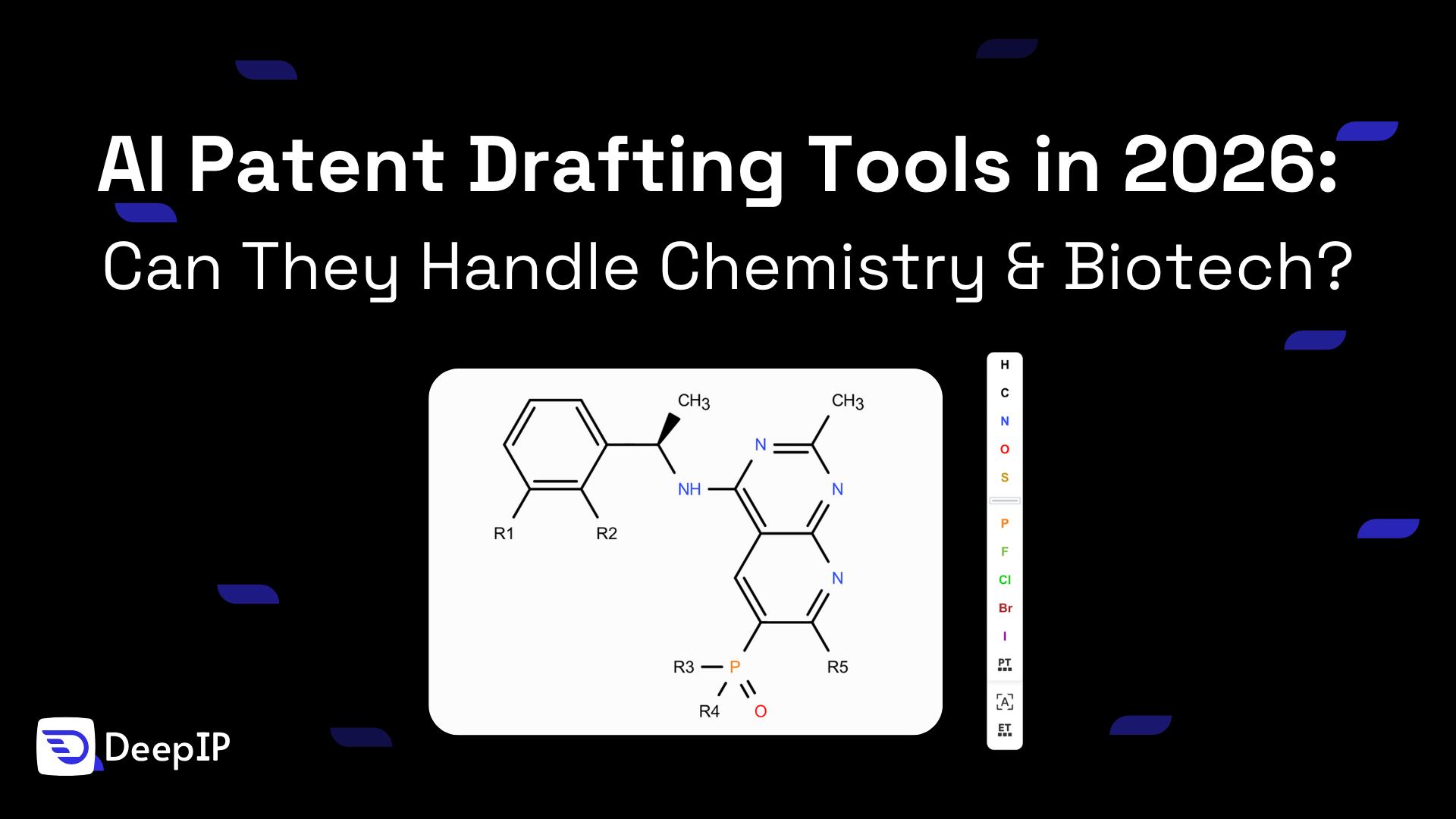
At the drafting level, DeepIP constrains molecular structure and claim scope; it can generate chemical drawings, scaffold variants, and Markush structures that remain internally consistent across the application—capabilities text-only LLMs inherently lack.
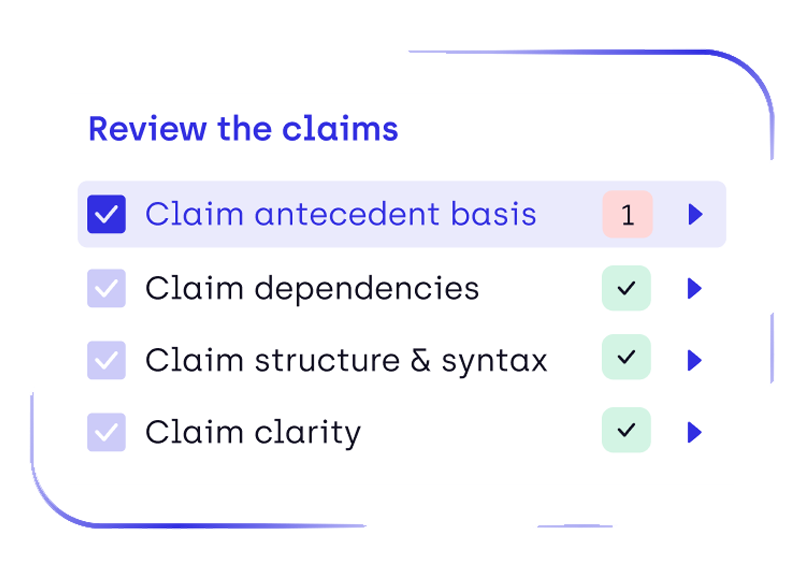
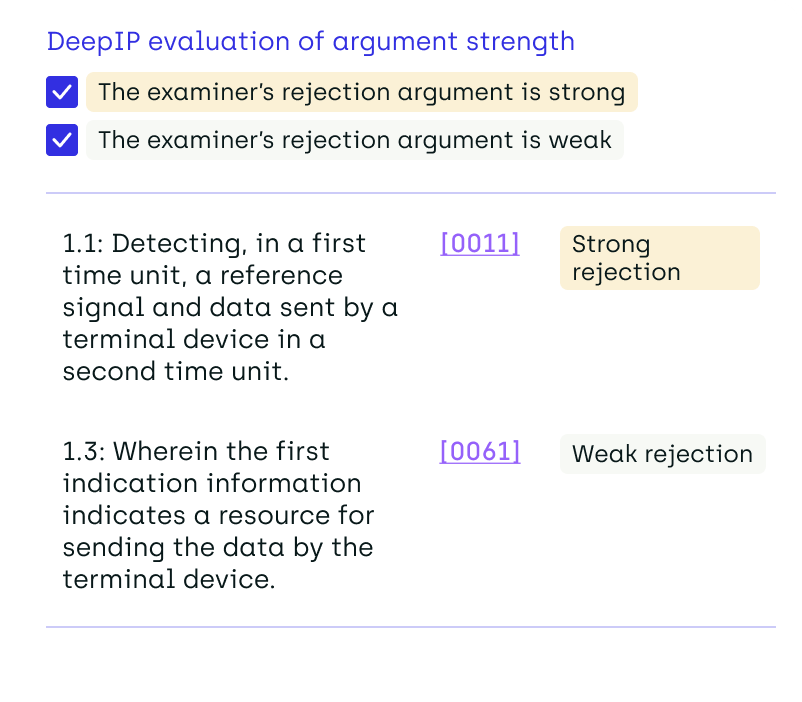
At the review level, it exposes support gaps, dependency issues, and structural inconsistencies that no language-first model can reliably detect. Its agentic layer continuously tests, validates, and refines drafts—ensuring chemical fidelity, legal coherence, and disclosure alignment before the human team ever touches the document.
For life science teams managing high-value portfolios, this approach restores confidence that acceleration does not come at the expense of correctness.
.png)