AI for Life Science Patents: Debunking Myths in Chemical & Biotech Patent Drafting

AI is transforming the IP landscape, but nowhere is the shift more misunderstood than in life science patents. Chemistry and biotechnology demand a level of precision, scientific reasoning, and interdisciplinary context that even the most advanced AI systems struggle with.
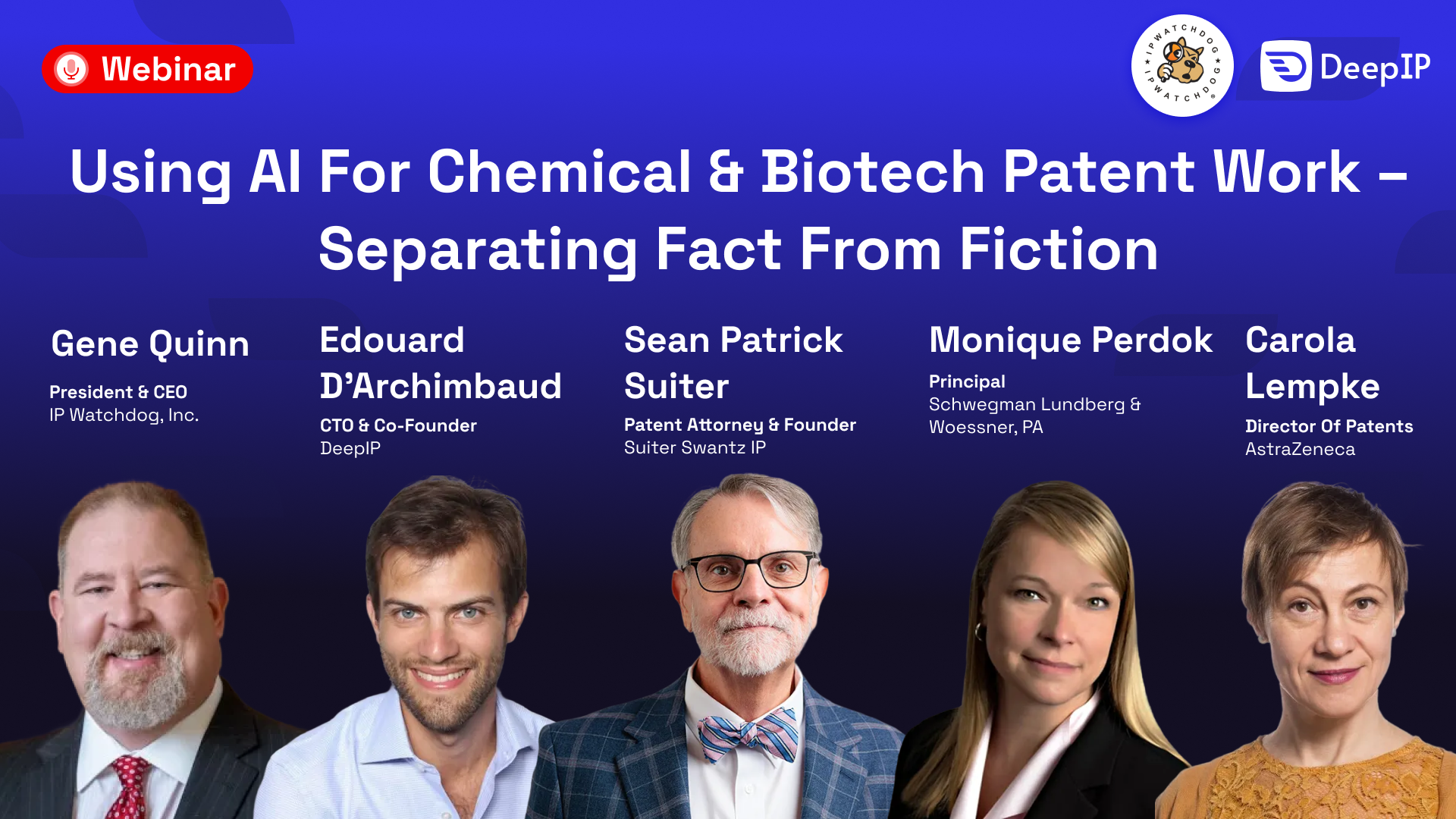
To understand whether AI is actually shifting the day-to-day work in these fields, DeepIP partnered with IPWatchdog in a webinar featuring industry leaders:
- Carola Lempke, Director of Patents, AstraZeneca
- Monique Perdok, Principal, Schwegman Lundberg & Woessner
- Sean Patrick Suiter, Founder, Suiter Swantz IP
- Edouard d’Archimbaud, CTO & Co-Founder, DeepIP
- Moderated by Gene Quinn, Founder of IPWatchdog
Their insights reveal a fast-evolving field full of potential—yet surrounded by persistent myths.
Below, we debunk the myths around AI for life science patents—including its use in chemical patent drafting, biotech patent drafting, and high-complexity IP workflows—and uncover what the panel says is actually true.
Survey responses from attendees—spanning in-house teams, R&D, law firms, and IP operations—help paint the picture of how the industry is thinking about AI today.
Myth #1: AI will immediately deliver efficiency gains in drafting for life science patents
Why this myth persists
GenAI’s reputation precedes it. If AI can instantly generate emails, articles, and code, it seems reasonable to expect it can accelerate patent drafting too. And with 55% of webinar participants identifying drafting high-quality applications efficiently as their biggest bottleneck, the desire for automation is clear.
Life science practitioners—especially in chemistry and biotech—face enormous pressure to reduce drafting time while handling increasingly complex data.
Reality: AI enhances quality long before it improves speed
Every panelist agreed: AI for life science patents today is a quality tool, not a shortcut.
Suiter cautioned that prioritizing speed produces a “mediocre work product.” For him, AI’s real value lies in analyzing claim families, ensuring consistency, and maintaining clarity across complex disclosures.
Perdok described AI as a cure for “blank page syndrome,” not a replacement for scientific or legal reasoning. It sparks direction, exposes angles she may not have considered, and helps her break through structural bottlenecks.
Quinn compared drafting with AI to directing a production: you guide, refine, and iterate, not hand off responsibility.
The bottom line:
AI accelerates thinking, not typing. For life science patents, quality gains come first—time savings will follow later.
Myth #2: AI patent tools are too generic to handle the complexity of life science inventions
Why this myth persists
Most practitioners first encounter AI through general-purpose chatbots. These models are fluent—they can summarize, explain, and generate text convincingly. But hand them a peptide sequence, a Markush structure, a reaction scheme, or an ST.26 listing, and they often fail in unpredictable ways.
Given that exposure, it’s understandable that professionals across in-house teams (41%), R&D (7%), IP operations (8%), and law firms (24%) assume that AI for life science patents is just a fancier version of the same generic technology.
And because much of the public conversation about AI for patents focuses on broad LLMs, a persistent belief has formed: that AI simply isn’t specialized enough for chemical or biotech patent drafting.
Reality: Domain-specific engineering and structured inputs make AI highly reliable for chemical and biotech patent drafting
Lempke emphasized that vague or unstructured inputs—slides, screenshots, inventor shorthand—force any model to guess. But when the model is given structured scientific text, accuracy improves dramatically.
Perdok has shifted her entire prompting workflow: she now feeds models complete documents, including ST.26 sequences, examples, references, and case law. The quality of reasoning improves immediately.
D’Archimbaud explained why this happens: LLMs are powerful reasoning engines, but only when grounded in well-formatted scientific data and supported by domain-specific pre-processing—a requirement in AI for biotech and chemical patent drafting.
This is why specialized tools built for life science patent workflows provide capabilities general models lack, including:
- SDF, CDX, and Molfile compound ingestion
- ST.26 XML and FASTA sequence processing
- CDR identification for biologics
- Automated IUPAC, SMILES, and other chemical conversions
- Markush structure visualization and editing
These pipelines transform raw scientific materials into something an AI system can reason over safely and consistently.
The bottom line:
The issue isn’t that AI can’t understand life sciences.
It’s that generic AI isn't trained for it—but domain-specific tools designed specifically for AI in life science patents absolutely can.
When paired with structured inputs, specialized models become exceptionally accurate, consistent, and dependable across real patent drafting workflows.
Myth #3: AI hallucinations make it unsafe for life science patent drafting
Why this myth persists
Hallucinations are headline-friendly. And in life sciences—where a single incorrect variant, structure, or sequence can undermine enablement—they feel especially dangerous. Several webinar attendees noted that reviewing large technical specs for consistency and accuracy remains a major challenge, adding to concern.
Reality: Hallucinations follow predictable patterns and can be controlled
Panelists emphasized that hallucinations in life science workflows don’t happen randomly—they occur when:
- Context is incomplete
- Acronyms are ambiguous
- Data is unstructured
- The model is asked to infer missing information
- Document boundaries are unclear
Suiter compared AI to a brilliant junior associate: powerful, but inexperienced. With proper supervision and clear constraints, performance improves dramatically.
D’Archimbaud highlighted how domain-specific pipelines—chemical parsers, sequence validators, scaffold extraction algorithms—have reduced hallucinations significantly in the last six months.
The bottom line:
AI hallucinations are a quality control issue, not a reason to reject AI for life science patents. Proper context and constraints make them manageable.
Myth #4: All AI tools for life science patents offer the same level of security
Why this myth persists
Patent professionals often encounter AI first through public platforms—systems that promote “security,” “encryption,” or “privacy” in broad terms. This makes it easy to assume that if one AI tool says it’s secure, then every tool in the market approaches data security the same way.
But in chemical and biotech innovation—where sequence listings, formulations, assay data, mechanisms of action, and clinical insights represent some of the most sensitive IP assets on earth—practitioners need more than generic assurances. They need confidence that AI for life science patents is engineered to protect their data at every layer.
Reality: Security models differ dramatically—and specialized life science AI tools take a fundamentally different approach
Lempke stressed that for enterprise in-house teams, the question is never just “Is this secure?” but “How exactly does it secure my disclosures?”
Without complete transparency on data handling, retention, and training practices, adoption simply does not move forward.
D’Archimbaud explained that securing chemical and biotech patent data requires more than standard SaaS safeguards. It requires purpose-built infrastructure—something general LLM platforms were never designed for.
DeepIP’s model is one example of what this looks like in practice:
- Customer data is never used for model training
- All files fully encrypted and logically segregated
- ISO 27001 and ISO 42001 certified
- Private-tenant and fully on-premise deployment options
- Human-in-the-loop review for every generated output
These safeguards match the realities of organizations managing sensitive R&D, FTO analyses, clinical development, and proprietary compound/sequence data.
The bottom line:
Not all AI tools secure patent data the same way. And that’s why life-science teams increasingly rely on domain-specific AI for life science patents, built with confidentiality-heavy workflows in mind.
In this domain, tailored security architecture isn’t a “feature”—it’s the prerequisite that makes safe adoption possible.
Myth #5: To adopt AI, practitioners must overhaul their drafting workflow
Why this myth persists
Early AI tools forced patent teams to switch platforms, rewrite processes, or abandon familiar environments. Given that many attendees noted challenges collaborating across R&D, in-house counsel, and outside counsel, workflow disruption feels risky.
Reality: Modern AI works best when it fits into existing drafting tools
In the webinar, d’Archimbaud demonstrated DeepIP’s integration directly into Microsoft Word—the core drafting environment for nearly all practitioners working with life science patents.
This allows:
- Claim drafting (including composition, method, Markush)
- Chemical structure processing
- Sequence interpretation and CDR extraction
- Invention summaries
- Inventor interview preparation
- §101 eligibility assessment
- Terminology and definition drafting
- Experimental example creation with change tracking
All within the document editor. No tab switching. No lost formatting. No separate environment for AI.
The bottom line:
The best AI for life science patents integrates into your current workflow; it doesn’t replace it.
Myth #6: Most practitioners are waiting to see whether AI is worth adopting
Why this myth persists
Life science patent professionals tend to be cautious, and rightfully so. Many assume others are holding back as well, especially in high-stakes domains like chemistry and biotech.
Reality: The adoption gap is widening—quickly
Quinn warned that examiners themselves are experimenting with AI. Practitioners who delay risk falling behind. Perdok encouraged hesitant users to start with a safe case—an issued patent, a known sequence listing—just to learn how the tools think. Suiter emphasized that AI enables deeper exploration, especially across related families or patents with shifting priority dates.
And across the audience, practitioners from in-house teams, R&D, and law firms expressed active interest—not passive observation.
The bottom line:
Waiting is no longer neutral. Early adopters are developing an advantage that will compound over time.
The Truth About AI for Life Science Patents
The myths surrounding AI for life science patents, chemical drafting, and biotech workflows persist for understandable reasons: the technology is evolving, the science is complex, and the stakes are high.
But across all expert insights, one truth emerges clearly: AI doesn’t replace scientific or legal expertise—it elevates it.
It helps practitioners think more strategically, structure more clearly, and analyze more deeply. And when designed specifically for life science patents—with chemical parsing, sequence understanding, and secure deployment—AI becomes a force multiplier, not a risk.
For chemical, biotech, and broader life science patent teams, the question is no longer whether AI will shape the future of drafting and prosecution. It already is. The question is how quickly, and how safely, you choose to adopt it.
.avif)