
Built for Markush structures, stereochemistry, and experimental data that generic tools get wrong.









Chemistry Patent AI
The highest-quality chemistry drafts, every time.
DeepIP removes the mechanical work that slows experts down, so chemists and patent attorneys can focus on claim scope, fallback strategy, and defensibility.
Other tools produce generic text. DeepIP produces prosecution-ready chemistry.
Broader protection, less risk.
DeepIP helps chemists and patent attorneys turn compounds, structures, and experimental data into prosecution-ready chemistry drafts—while preserving chemical validity, internal consistency, and support from examples to claim scope.
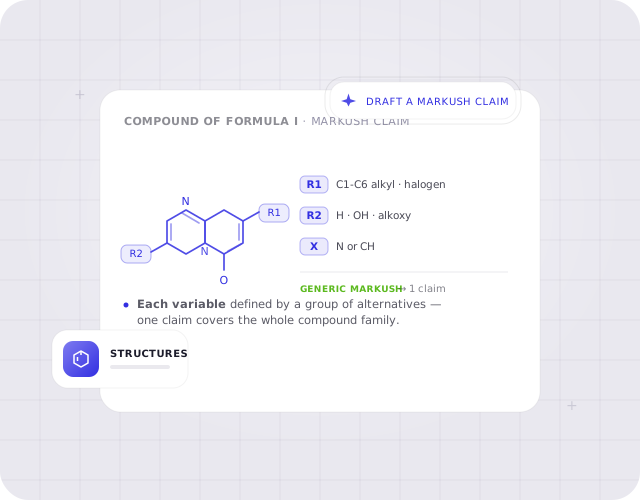
Markush drafting, grounded in chemistry.
DeepIP suggests an initial Markush formula or genus with substituents, then lets you refine it visually or in chat to build defensible broad-to-narrow fallback formulas.
Exemplified compounds stay in view as scope evolves, ensuring coverage remains chemically coherent and grounded throughout the draft.
Preserve chemical meaning, end to end.
Subscripts, superscripts, stereochemistry, symbols, ring systems, and structural notation are preserved across ingestion, drafting, and export.
DeepIP is built to protect chemical meaning, not just document formatting.
Turn experimental data into patent-ready examples.
Raw chemist notes, tables, and experimental results are hard to convert cleanly into patent examples.
DeepIP helps structure that material into drafting-ready experimental sections while preserving values, units, ranges, and technical detail.
Enterprise-grade security.
Your patent data is protected by the highest industry standards. Deployed on Microsoft Azure with end-to-end encryption.


Microsoft Word
Draft and review patents directly within your familiar Word environment.

Outlook
Manage office action deadlines
and receive AI-powered response suggestions.
Docketing systems
Seamless integration with leading IP management platforms.
REST API
Build custom integrations with a comprehensive, well-documented API.
Go deeper.
Questions & answers.

What makes DeepIP different for chemistry patent drafting?
DeepIP is built to handle the structural complexity of chemistry patents. It preserves chemical notation, stereochemistry, subscripts, superscripts, and structural representations while helping transform compounds, Markush formulas, and experimental data into prosecution-ready drafts.
Can DeepIP help with Markush structures and genus claims?
Yes. DeepIP can suggest an initial Markush formula or genus and help refine substituents to build defensible broad-to-narrow fallback structures. As scope evolves, exemplified compounds remain visible so you can confirm coverage while maintaining chemical coherence.
How does DeepIP handle chemical structures and notation?
DeepIP is designed to preserve chemical meaning throughout drafting. Structural notation, stereochemistry, ring systems, and formatting are maintained across ingestion, drafting, and export so the chemistry remains accurate.
Can DeepIP convert experimental data into patent examples?
Yes. DeepIP helps structure experimental procedures, tables, and data into drafting-ready experimental sections while preserving values, units, ranges, and technical details.
Is DeepIP meant to replace chemists or patent attorneys?
No. DeepIP is designed to assist experts, not replace them. It removes repetitive drafting work so chemists and patent professionals can focus on claim scope, fallback strategy, and defensibility.
What types of chemistry patents can DeepIP support?
DeepIP can assist with patents involving small molecules, pharmaceutical compounds, chemical compositions, and other chemistry-driven innovations where structures, substituents, and experimental data are central to the disclosure.
How does DeepIP help ensure chemical consistency in a draft?
DeepIP maintains formulas, structures, and exemplified compounds as grounded context throughout drafting. This helps ensure claims, descriptions, and examples remain technically consistent as the document evolves.
The go-to platform for IP practitioners.
Join the IP teams already working this way who have transformed their workflows with AI-powered patent intelligence.