Why Freedom to Operate (FTO) and Invalidity Analysis No Longer Needs to Take Weeks
.png)

Freedom to operate (FTO) analysis and patent invalidity search sit at the center of some of the most consequential decisions made by innovation-driven companies. Together, they shape whether a product can launch, whether a licensing agreement is viable, whether an acquisition introduces hidden exposure, and whether litigation risk is manageable.
Despite this importance, many organizations still approach these analyses as slow, sequential exercises. Freedom to operate reviews routinely stretch into weeks, while invalidity analysis is often deferred until disputes arise. In fast-moving innovation environments, especially in life sciences, biotech, chemistry, and advanced engineering, this creates a widening gap between business velocity and legal certainty.
Product development cycles are compressing. Competitive pressure is intensifying. Yet IP risk assessment workflows often remain anchored to legacy timelines, forcing decisions to be made with incomplete visibility or under last-minute urgency.
That model is increasingly being challenged. Leading IP organizations are demonstrating that rigorous freedom to operate and invalidity analysis can be completed in days rather than weeks, without compromising analytical depth or defensibility. This shift is not the result of marginal efficiency gains. It reflects a fundamental rethinking of how patent risk analysis is structured, sequenced, and operationalized.
Why Traditional Freedom to Operate Analysis Takes So Long
To understand why timelines are changing, it is important to examine why these analyses have historically been slow.
Traditional freedom to operate analysis is built on sequential, document-centric workflows. Search, screening, and analysis are treated as distinct phases rather than integrated activities. Invalidity search is typically separated entirely from early FTO work.
In a conventional approach:
- Broad prior art searches are conducted first, often driven by manually constructed keyword strategies and classification codes
- Coverage is expanded jurisdiction by jurisdiction to account for where products may be made, used, or sold
- Claim-level analysis begins only after a large body of potentially relevant patents has already been assembled
- Invalidity considerations are deferred until later stages or separate matters
This structure made sense when patent datasets were smaller and innovation cycles were slower. Today, it increasingly works against both speed and strategic clarity.
Patent Volume and Landscape Complexity
One of the biggest contributors to slow FTO analysis is the sheer scale of the modern patent system.
Global patent filings now exceed 3.5 million applications per year, dramatically increasing the size of the universe that must be searched and filtered during freedom to operate and invalidity reviews. Industry analyses note that this growth directly expands the scope and effort required for comprehensive FTO searches, particularly in technology-dense fields such as life sciences and chemistry.
Structural complexity compounds the problem. For example, the USPTO alone reported a backlog of hundreds of thousands of unexamined patent applications, reflecting the volume of pending rights that may later mature into enforceable claims.
For FTO analysis, this means teams must consider not only granted patents, but also pending applications whose claims may evolve over time.
Screening Comes Before Insight
In dense patent landscapes, traditional workflows generate large result sets early in the process. This creates several inefficiencies:
- Significant time spent screening documents that ultimately pose little or no real risk
- Relevance decisions made late, after substantial effort has already been invested
- Invalidity treated as a downstream exercise rather than an early signal
As patent practitioners note, freedom to operate analysis requires careful comparison of product features against existing patent claims to assess infringement risk—a task that is inherently time-consuming when applied across large document sets.
Static Outputs in a Dynamic Environment
The end result for many organizations is familiar:
- Long lead times before meaningful conclusions emerge
- High internal effort spent on screening rather than legal judgment
- Static reports that quickly fall out of date as products, processes, or geographies change
Patent authorities and international organizations have acknowledged this growing strain. WIPO’s work on patent analytics highlights that patent analysis has become a data-intensive, multi-step process, requiring specialized tools and methodologies as patent volumes and technical complexity increase.
Together, these factors explain why traditional freedom to operate analysis often stretches into weeks. The slowdown is not primarily due to lack of expertise, but to workflows that were never designed for the scale and complexity of today’s patent landscape.
Rethinking the Timeline: From Sequential to Insight-First Analysis
Accelerating freedom to operate and invalidity analysis does not mean lowering standards or cutting corners. It means changing where analytical effort is applied.
Modern workflows shift emphasis away from exhaustive document collection and toward early identification of risk-driving claims. Rather than treating every potentially relevant patent equally, analysis is structured to surface the small subset of claims that materially affect both freedom to operate and validity risk.
This reframing allows teams to answer critical questions much earlier, including:
- Which claims pose genuine blocking risk to the product or process?
- Which risks are likely structural, and which may be mitigated?
- Where does deeper invalidity analysis meaningfully change the outcome?
By front-loading insight rather than documentation, IP analysis becomes decision-supportive earlier in the lifecycle, when commercial and technical options are still open.
The Role of AI in Accelerating Both FTO Analysis and Invalidity Search
AI has become a critical enabler of this shift, particularly for organizations managing large portfolios and complex technologies. Its value lies not in replacing legal judgment, but in removing structural inefficiencies that slow traditional workflows.
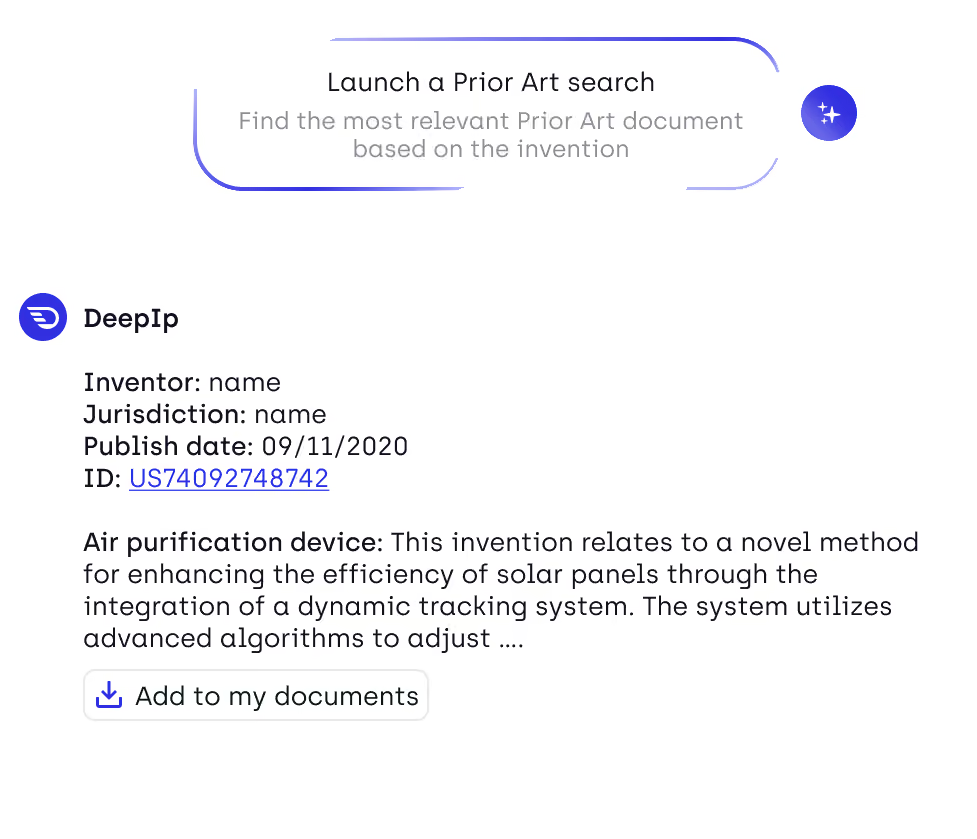
Modern patent search systems operate at a scale that manual approaches cannot match. Semantic and structural analysis allows relevant patents and publications to be identified across jurisdictions and languages without relying solely on keyword matching. This significantly reduces the time required to achieve high recall, which remains foundational for both FTO and invalidity work.
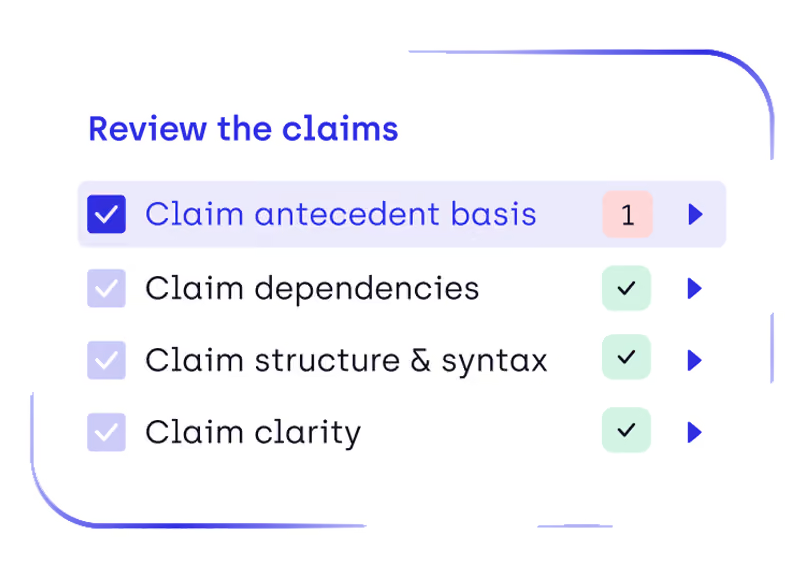
Equally important is the move toward claim-centric analysis. Instead of evaluating relevance at the document level, newer systems map product features and technical elements directly against claim language. Potentially blocking claims and vulnerable claims surface earlier, allowing teams to focus their expertise where it matters most.
For IP professionals, the impact is practical and immediate:
- Less time spent screening low-impact references
- More time spent interpreting claim scope and legal risk
- Earlier engagement with R&D and business stakeholders
Bringing Invalidity Analysis Upstream
Historically, patent invalidity analysis has been treated as a downstream activity, most often triggered by litigation or enforcement actions. In many organizations, it remains siloed from early freedom to operate assessments.
That model is increasingly being reconsidered.
As patent landscapes grow denser, it has become impractical to treat validity questions as purely reactive. When potentially blocking claims are identified during an FTO review, understanding whether those claims are likely to withstand scrutiny becomes strategically relevant immediately, not later.
Integrating invalidity analysis earlier allows teams to layer prior art evaluation into FTO workflows, providing early signals that support prioritization. This does not replace full invalidity analysis. Instead, it helps teams distinguish:
- Which risks are likely unavoidable and demand redesign or licensing
- Which may be mitigated through challenge or negotiation
- Where deeper investment of time and budget is justified
For organizations managing multiple products or pipelines, this prioritization is essential. It prevents resources from being spread evenly across risks that are not equally consequential.
From One-Time Reviews to Continuous Risk Visibility
In practice, neither freedom to operate nor invalidity risk is static.
Products evolve. Manufacturing processes change. Geographic scope expands. Competitor portfolios grow as new applications publish and patents grant. Treating IP risk analysis as a one-time exercise increasingly fails to reflect how innovation actually happens.
Accelerated workflows enable a shift toward continuous visibility:
- Newly published or granted claims can be flagged automatically
- Risk assessments can be updated without restarting analysis from scratch
- Teams maintain decision-ready insight as portfolios and products evolve
This is particularly valuable in regulated industries, where development timelines often span years and IP risk must be managed continuously rather than episodically.
What to Look for in Accelerated FTO and Invalidity Solutions
Speed alone is not sufficient. For enterprise environments, acceleration must be compatible with rigor, governance, and defensibility.
Key considerations include:
- Technical depth, including support for complex claim structures and highly technical disclosures
- Explainability, with clear reasoning paths that can be reviewed and defended
- Workflow integration that supports collaboration with outside counsel and portfolio strategy
- Consistency across products, jurisdictions, and reviewers
This is where platforms like DeepIP play a central role.
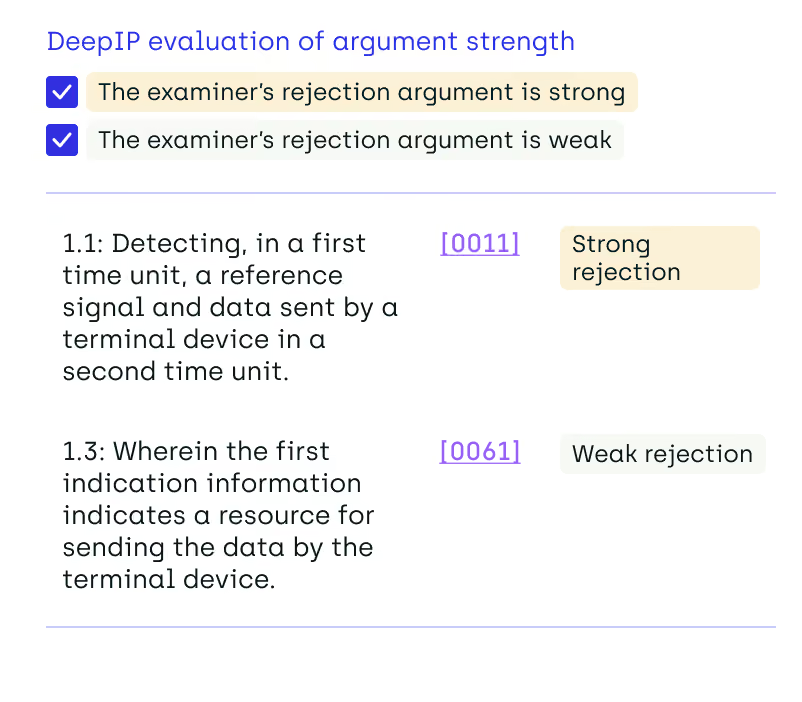
By combining high-recall search, claim-level analysis, explainable reasoning, and continuous monitoring, DeepIP enables organizations to run both freedom to operate and invalidity analysis on compressed timelines without sacrificing analytical integrity. Rather than automating isolated tasks, it provides the infrastructure needed to operationalize accelerated, insight-first IP workflows across the patent lifecycle.
How Faster Analysis Changes the Role of IP
When freedom to operate and invalidity analysis can be completed in days rather than weeks, the role of IP shifts materially.
IP teams gain earlier influence over R&D and commercialization decisions. Licensing and negotiation strategies are informed by clearer, earlier risk visibility. Escalations to outside counsel become more targeted and less reactive.
Most importantly, IP moves upstream, from a downstream checkpoint to a decision-support function embedded in innovation strategy.
A New Baseline for Patent Risk Analysis
Running freedom to operate and patent invalidity analysis in days rather than weeks is no longer aspirational. For organizations operating in dense, competitive patent landscapes, it is becoming the new baseline.
The differentiator is not willingness to move faster, but the infrastructure that makes speed compatible with rigor. Teams that adopt accelerated, claim-centric, and explainable workflows are better positioned to manage patent risk at the pace modern innovation demands.
In an environment where business decisions increasingly outpace traditional legal analysis, one conclusion is clear: patent risk analysis that arrives too late is functionally incomplete, no matter how thorough it may be.
.avif)