5 Questions IP Teams Should Ask Before Adopting AI | Stephanie Curcio


Artificial intelligence is no longer a future consideration in patent law—it is already embedded across drafting, search, prosecution, and portfolio strategy. From AI-powered prior art search to AI-generated patent drafting, AI in patent practice is rapidly becoming the norm rather than the exception.
In a recent episode of IP Innovators, Stephanie Curcio, CEO and co-founder of NL Patent, shared a practitioner-focused perspective on AI adoption in patent law, shaped by her experience as a former patent attorney and long-time legal tech founder. Her message is clear: while AI tools for patent professionals are more powerful and accessible than ever, their value depends entirely on how they are evaluated, implemented, and measured.
Below are five critical questions patent professionals, in-house IP teams, and law firms should ask before adopting—or expanding—their use of artificial intelligence in patent law.
1. How Are We Defining Patent AI ROI?
One of the most common mistakes in AI adoption is equating return on investment with speed alone. Faster drafting, faster review, and faster responses are often treated as the primary indicators of success. But in patent practice, patent AI ROI cannot be measured solely in minutes saved.
Curcio emphasizes that efficiency is only one dimension of value. AI systems that marginally slow a drafter but improve claim clarity, reduce rework, or strengthen patent protection may deliver far greater long-term ROI than tools that simply produce output more quickly.
Patent teams should evaluate ROI across the entire workflow, including:
- Time per task from invention disclosures through office action responses
- Reduction in examiner objections or downstream amendments
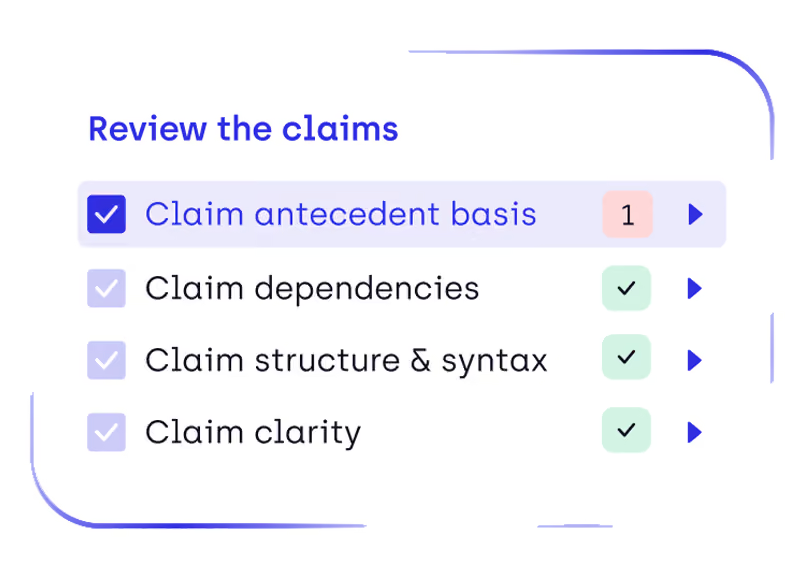
- Improvements in claim language consistency and enforceability
- Attorney confidence in AI-assisted work product
In patent law, quality and durability matter just as much as speed. A well-measured ROI framework reflects that reality.
2. Where Might AI Systems Be Introducing Hidden Inefficiencies?
AI tools often remove friction in one part of a workflow while introducing it elsewhere. Prompting, reviewing AI-generated content, validating outputs, and reconciling results with firm style guidelines all require time and attention.
Curcio cautions that perceived efficiency gains can mask new bottlenecks—especially when AI technologies are layered onto existing workflows without rethinking how work is actually performed.
Patent practitioners should examine:
- Whether attorneys are double-checking AI output more frequently
- How much time is spent editing or restructuring AI-generated text
- Whether AI capabilities change collaboration between patent attorneys and agents
- If downstream steps in prosecution take longer as a result of upstream automation
Successful AI adoption in patent practice requires workflow redesign—not just tool deployment.
3. Do We Understand How AI Tools Handle Patent and Client Data?
As artificial intelligence becomes ubiquitous, even legacy legal software now ships with embedded AI features. This raises important questions about confidentiality, compliance, and data handling—especially for patent professionals managing sensitive technical disclosures.
Curcio highlights the importance of understanding:
- Where patent data is stored and processed
- Whether inputs are retained or used to train AI systems
- How new AI features affect existing terms of service
- What security standards vendors apply to AI technologies
This is particularly relevant as guidance from the US Patent and Trademark Office (USPTO) continues to evolve around AI, inventorship, and disclosure obligations. Patent teams must ensure that AI-generated content does not compromise compliance with requirements related to the human inventor, patent ownership, or enforceability of the claimed invention.
Every AI capability—whether newly adopted or quietly added to existing software—should be treated as a fresh risk assessment.
4. Should We Build, Buy, or Combine AI Tools?
The long-dormant build vs. buy debate is quietly re-emerging in patent law. Advances in AI systems, APIs, and low-code platforms have significantly lowered the barrier to building internal tools tailored to firm-specific workflows.
At the same time, specialized vendors continue to deliver sophisticated AI tools for patent professionals—particularly in areas like large-scale patent search, analytics, and model training—that are difficult to replicate in-house.
Curcio suggests that many organizations will land on a hybrid approach:
- Buy best-in-class AI tools where vendors have deep expertise
- Build lightweight internal solutions for niche or proprietary workflows
- Integrate tools modularly rather than forcing a single platform to handle everything
This strategy allows patent teams to remain agile while aligning AI adoption with long-term patent strategy and business goals.
5. Are We Measuring Success—or Just Celebrating Adoption?
Rolling out AI tools is easy. Ensuring they deliver sustained value takes concentrated effort.
Curcio emphasizes that AI adoption should be treated as an ongoing process rather than a one-time milestone. Patent teams should define success metrics upfront and revisit them regularly as AI capabilities and workflows evolve.
Best practices include:
- Establishing clear benchmarks before deployment
- Reassessing tools as patent portfolios and strategies change
- Retiring AI systems that fail to deliver measurable value
- Investing in training so patent attorneys understand both the strengths and limits of AI
In patent practice, competitive advantage will belong to organizations that adopt AI deliberately—not those that adopt it fastest.
How Patent Teams Can Operationalize AI Adoption Today
Artificial intelligence in patent law is already influencing prior art search, patent search, invention disclosures, and drafting support. The next phase of adoption will focus less on experimentation and more on operational excellence.
Patent professionals should consider:
- How AI-generated drafts fit into existing quality control processes
- Whether AI capabilities improve or complicate claim drafting
- How AI systems support long-term patent protection and enforcement
- How AI tools align with evolving guidance from the USPTO
As AI technologies mature, firms that treat AI as a strategic capability—rather than a standalone tool—will be better positioned to adapt.
Why Intentional AI Will Define the Next Era of Patent Practice
Stephanie Curcio’s perspective reflects a broader shift underway across the IP ecosystem. AI tools are no longer experimental, but their value is not guaranteed. The firms and in-house teams that succeed will be those that measure patent AI ROI honestly, understand how AI systems affect real workflows, and align technology decisions with patent strategy.
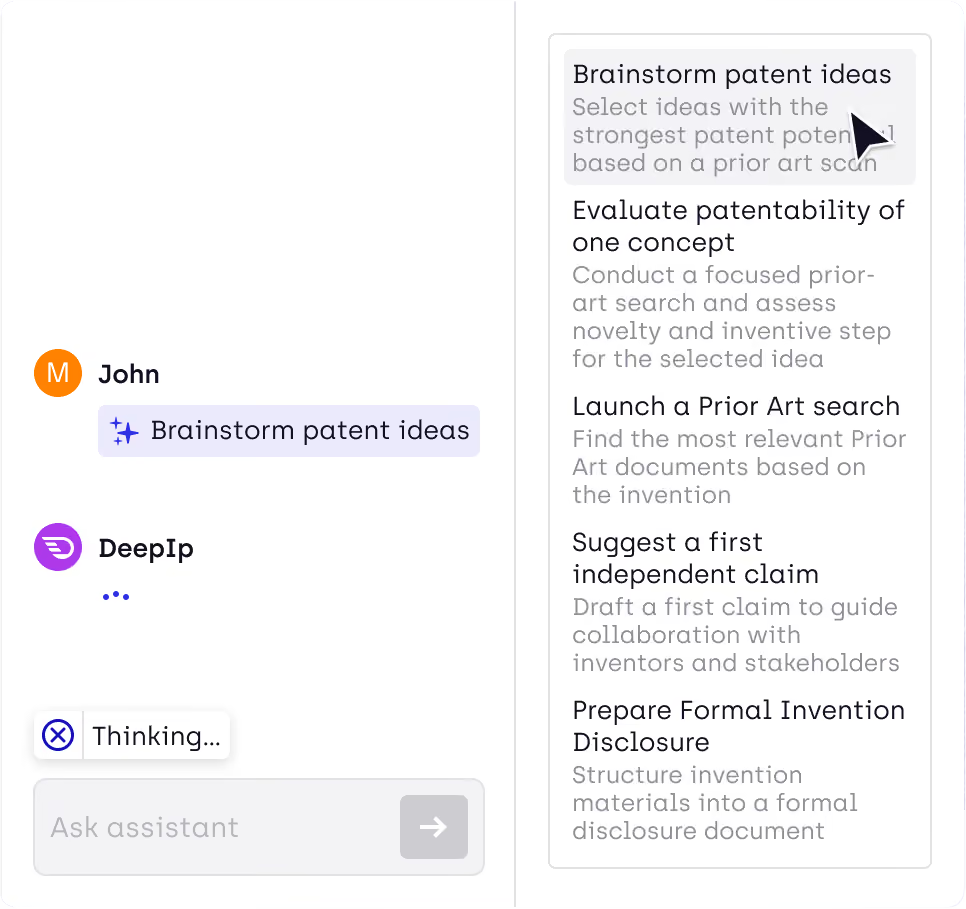
At DeepIP, we believe AI should support patent professionals where they already work—inside familiar drafting and prosecution environments—while delivering measurable improvements in speed, accuracy, and confidence.
.avif)