Best AI Patent Search Tools vs Integrated Patent Analysis Platforms (2026 Guide)
.png)

Why Patent Search & Analysis Tools Matter More Than Ever
The market for AI patent search tools has expanded rapidly. At the same time, a new wave of patent analysis software and broader IP intelligence tools in 2026 promise portfolio visibility, automated scoring, and strategic dashboards.
For IP leaders evaluating platforms today, the key question is no longer simply: Which tool has the strongest prior art search?
The more important question is: How does patent search integrate into the broader patent lifecycle, and does the platform compound intelligence across patent drafting, prosecution, invalidity search, and portfolio management?
In 2026, the most meaningful distinction in the market is not just search quality or analytics sophistication. It is architectural design: standalone search engines versus integrated patent workflow platforms.
This comparison explores that difference.
Two Architectural Models in the AI Patent Search Market
When reviewing AI patent search tools, patent analysis software, and invalidity analysis software in 2026, most platforms follow one of two structural approaches. The difference is not simply about features. It reflects how each vendor believes patent search should function within the broader IP lifecycle.
Some tools treat search as a specialized, standalone discipline. Others embed it into a connected patent workflow.
That architectural choice has long-term implications for how prior art intelligence is preserved—or lost—across drafting, prosecution, and portfolio strategy.
1. Standalone Prior Art Search AI Tools
Standalone prior art search AI tools are built around retrieval depth. Their core promise is precision, breadth, and advanced control over how references are surfaced.
They typically emphasize:
- Deep semantic prior art retrieval
- Advanced Boolean query control
- Broad global database coverage
- Litigation-focused invalidity search software features
- Domain-specific optimization for technical fields
These platforms are often strongest in contexts where search itself is the primary objective, such as:
- High-stakes invalidity investigations
- Complex technical patent mining
- Dedicated search teams with expert users
- Power-user environments requiring granular control
The advantage of this model is clear: sophisticated retrieval capabilities and extensive filtering flexibility.
However, once the search phase concludes, outputs are frequently exported into separate systems for patent drafting, patent analysis, prosecution, or portfolio review. As work moves forward, teams may rely on static reports, summaries, or PDFs rather than living search intelligence.
Over time, this separation can lead to:
- Reinterpretation of prior art across stages
- Repeated manual analysis
- Loss of contextual reasoning behind why references were identified
- Duplicated effort between search and prosecution teams
In this architecture, patent search is powerful, but largely isolated.
2. Integrated Patent Analysis Software and IP Intelligence Platforms
The second model embeds AI patent search tools directly into patent analysis software and broader IP intelligence tools.
Rather than treating search as a discrete step, these platforms connect prior art discovery to the full patent workflow, including:
- Patentability assessment
- Claim drafting and refinement
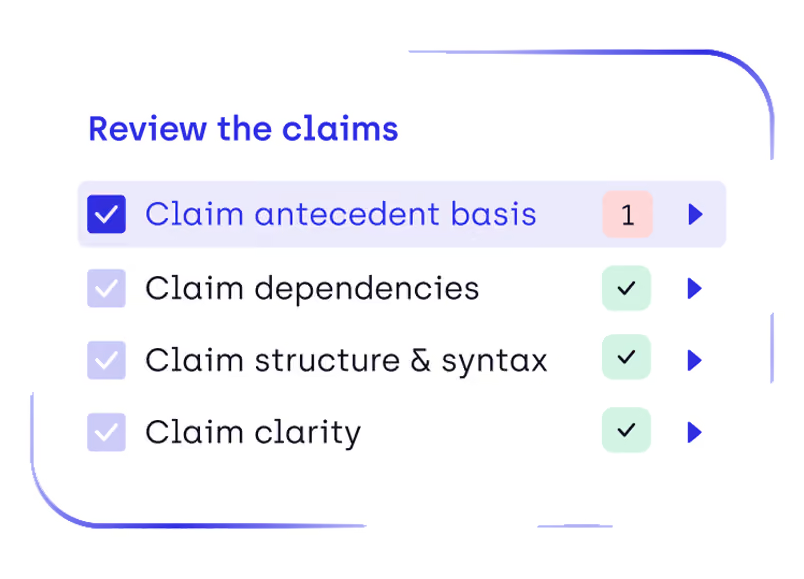
- Examiner-style review
- Office action preparation
- Invalidity analysis
- Portfolio intelligence and analytics
In this environment, prior art intelligence does not disappear after the search stage. It becomes a persistent layer of context.
For example:
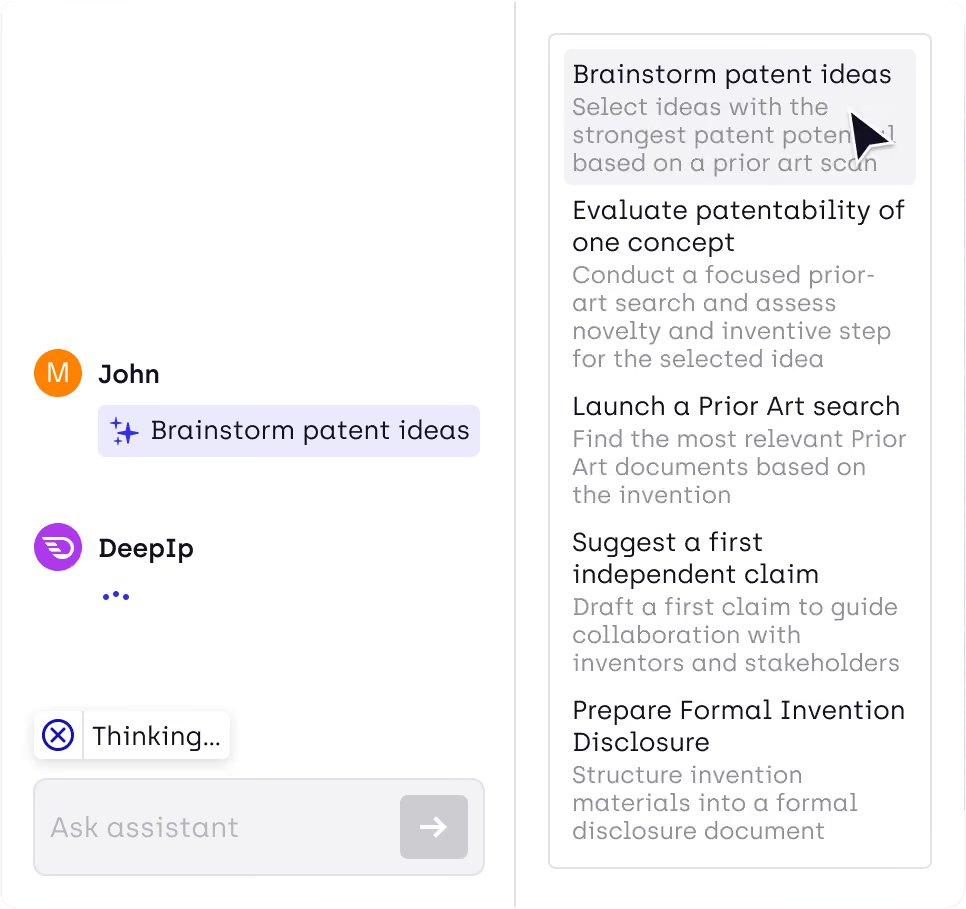
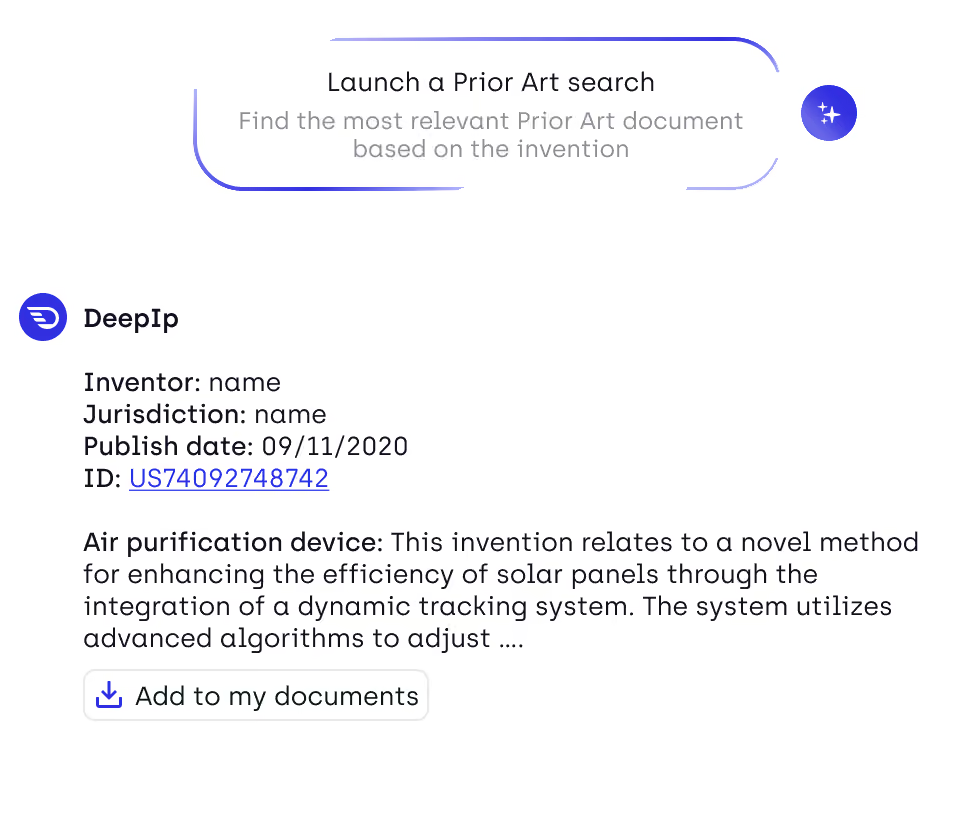
- References surfaced during search can inform drafting decisions in real time.
- Examiner-style objections are generated within the same environment as the underlying prior art.
- Portfolio insights are grounded in the same search intelligence used during filing and prosecution.
The structural difference is continuity.
Search becomes shared infrastructure rather than a standalone event. Context is preserved instead of reconstructed. Insights compound instead of resetting at each stage.
This integrated approach does not necessarily compete on maximum theoretical retrieval depth. Instead, it competes on lifecycle efficiency, consistency, and decision quality.
Why This Distinction Matters in 2026
As AI patent search tools evolve, the competitive landscape is shifting. The conversation is no longer only about which platform retrieves the most references.
IP leaders are increasingly asking:
- Does search intelligence flow into drafting automatically?
- Are invalidity insights connected to filing strategy?
- Does patent analysis software build directly on prior art reasoning?
- Are portfolio decisions grounded in the same search layer used during prosecution?
In other words, the evaluation lens is expanding from search strength to architectural design.
Standalone AI prior art search tools remain highly valuable in litigation-driven and specialist contexts. But for many corporate IP teams and law firms seeking scalable workflows, integrated patent analysis software and IP intelligence tools in 2026 may offer greater long-term leverage.
The real differentiator is not whether a platform performs patent search. It is whether patent search becomes part of a continuous, connected system.
Why Integration Matters More Than Raw Search Depth
Dedicated prior art search AI tools often excel at one thing: retrieval. For certain use cases, especially complex invalidity work, deep semantic recall and advanced filtering are critical. But retrieval depth alone does not determine strategic value.
In most IP organizations, the real impact of search is felt long after the initial prior art results are generated. Search intelligence influences decisions such as:
- Claim drafting and scope calibration
- Specification language refinement
- Examiner response strategy
- Continuation and divisional planning
- Portfolio pruning and filing prioritization
- Competitive positioning and risk assessment
Search is not an endpoint. It is an input. The problem arises when that input is disconnected from the stages that follow. In fragmented environments, teams often find themselves:
- Reconstructing search logic during prosecution
- Reinterpreting the same prior art across drafting and review
- Losing visibility into why specific references were initially surfaced
- Repeating analysis because context was flattened into static reports
Over time, this fragmentation introduces friction. It increases the risk of inconsistency between stages and makes knowledge transfer dependent on individual memory rather than system design.
Integrated patent analysis software addresses this differently. By embedding AI patent search tools directly into drafting, examiner-style review, and portfolio intelligence, prior art reasoning remains accessible throughout the lifecycle.
The advantage is not merely speed or convenience. It’s continuity, and the ability for search intelligence to persist, inform, and compound across multiple patent decisions without being reset at each stage.
In increasingly complex innovation environments, that continuity often matters more than marginal gains in standalone retrieval depth.
Comparing Evaluation Criteria for AI Patent Search Tools in 2026
As AI patent search tools, patent analysis software, and broader IP intelligence tools mature, evaluation criteria need to evolve as well.
Ranking platforms based solely on search strength or dashboard sophistication misses the architectural question underneath: how does prior art intelligence behave across the lifecycle?
When assessing the best patent analytics platforms in 2026, IP teams should look beyond feature lists and examine four structural dimensions.
1. Retrieval Power and Semantic Search Quality
Retrieval capability remains foundational. For certain use cases—particularly invalidity search software applications, high-risk litigation, and technically dense innovation domains—strong semantic search performance is essential.
Platforms built primarily around AI prior art search tools often excel in:
- Deep semantic similarity modeling
- Advanced filtering and Boolean refinement
- Extensive database coverage
For organizations with specialized search professionals, this level of control may be indispensable.
However, retrieval depth alone does not determine overall platform value. The question is not simply how much art can be found, but how that art is used after it is found.
2. Workflow Integration
This is where architectural differences begin to matter.
In many IP environments, search results are generated in one system and consumed in another. That handoff creates friction.
When evaluating patent analysis software, teams should consider whether:
- Prior art feeds directly into drafting environments
- Search insights inform patentability assessment automatically
- Examiner-style reviews are generated within the same platform
- Invalidity analysis builds directly on prior art discovery
Integrated platforms reduce the “handoff problem.” They allow search intelligence to remain embedded within the broader workflow instead of being translated repeatedly across tools.
3. Context Preservation
In fragmented workflows, prior art is often converted into static artifacts—PDFs, slide decks, or summary reports. While these outputs are practical, they flatten nuance.
What frequently disappears in the process includes:
- Conceptual similarity reasoning
- Structured relevance mapping
- Claim-to-reference alignment logic
Over time, this loss of context can create inconsistencies between drafting, prosecution, and portfolio decisions.
By contrast, integrated IP intelligence tools maintain structured prior art reasoning throughout the lifecycle. The same conceptual mappings that surfaced a reference during search remain accessible during claim refinement or examiner response preparation.
This continuity reduces interpretive drift.
4. Compounding Intelligence Over Time
Perhaps the most overlooked evaluation factor is whether search insights compound.
In standalone environments, patent search tends to be episodic. A search is conducted, results are reviewed, and the workflow moves forward. When a new stage begins—prosecution, invalidity, portfolio review—the process often resets.
In integrated patent analysis software, the lifecycle looks different:
- Prior art intelligence informs initial drafting.
- Drafting decisions shape prosecution strategy.
- Prosecution outcomes influence continuation planning.
- Portfolio intelligence reflects the same foundational search logic.
Each stage builds on the previous one. This compounding effect can deliver greater long-term value than marginal improvements in raw retrieval performance. Over time, continuity reduces duplication, strengthens strategic alignment, and improves defensibility across the portfolio.
Where Invalidity Search Software Fits
Invalidity search software often prioritizes:
- Deep prior art mining
- Aggressive semantic similarity
- Litigation-grade documentation
For certain high-stakes contexts, dedicated invalidity tools remain essential.
However, for many in-house IP teams, the majority of value lies in ensuring that invalidity insights align with drafting and prosecution strategies—not simply in expanding search breadth.
Integration determines whether invalidity findings influence future filings.
Best Patent Analytics Platforms in 2026: A New Evaluation Lens
When IP teams search for the “best patent analytics platforms,” the expectation is often centered on visualization and reporting capabilities—stronger dashboards, clearer portfolio mapping, or more refined competitive trend analysis.
Those features matter. But they are only as reliable as the search and prior art intelligence feeding them.
Analytics built on weak or disconnected search layers can create a false sense of precision. Trend lines may look sophisticated, portfolio heat maps may appear data-driven, yet the underlying relevance assumptions remain shallow or fragmented.
In 2026, the definition of the best patent analytics platforms is shifting. Leading IP intelligence tools are no longer evaluated solely on how well they visualize information, but on how well they integrate the full patent workflow.
The most robust platforms combine:
- AI patent search tools embedded directly into analysis environments
- Patent analysis software that builds on live prior art reasoning
- Invalidity workflows connected to filing and prosecution strategy
- Portfolio intelligence grounded in the same search logic used at earlier stages
- Examiner-style review integrated within the same system
The distinction is architectural. In standalone environments, analytics sit on top of disconnected search outputs. In integrated systems, analytics emerge from a continuous intelligence layer that runs from prior art discovery through drafting, prosecution, and portfolio management.
For IP leaders evaluating platforms in 2026, the question is no longer just which system produces the cleanest dashboards. It is which platform ensures that the intelligence behind those dashboards remains coherent, persistent, and actionable across the entire patent lifecycle.
DeepIP Patent Analysis: An Integrated Model
DeepIP patent analysis reflects the integrated model described above.
Rather than treating AI patent search tools as a standalone layer, DeepIP embeds search intelligence directly into the broader patent workflow. Prior art discovery is connected to the stages where it actually influences decisions—not separated from them.
Within DeepIP’s architecture, search intelligence flows into:
- Patentability review and early-stage assessment
- Drafting environments where claims are refined
- AI examiner-style analysis during prosecution preparation
- Invalidity and risk evaluation
- Portfolio intelligence and strategic oversight
The goal is not to compete on isolated retrieval depth, but to ensure that prior art reasoning remains accessible and usable throughout the lifecycle.
In practice, this means:
- References identified during search can inform claim language in context.
- Examiner-style analysis builds directly on the same prior art surfaced earlier.
- Portfolio insights reflect the same intelligence used during filing and prosecution decisions.
Search becomes shared infrastructure rather than a detached output.
For many IP teams, this integrated model reduces duplicated effort, minimizes contextual drift between stages, and improves consistency across drafting, prosecution, and portfolio strategy. The value emerges not from any single feature, but from continuity across the entire patent workflow.
When Standalone AI Patent Search Tools Make Sense
Dedicated prior art search AI tools continue to play an important role in the IP ecosystem. In certain environments, their strengths are decisive.
For example, standalone search platforms are often well suited to situations where:
- Litigation requires maximum retrieval depth and aggressive prior art mining
- Experienced search specialists need granular Boolean control and advanced filtering
- Highly specialized or domain-specific databases are central to the analysis
In these contexts, retrieval performance and query customization may outweigh workflow considerations.
However, not all IP teams operate in litigation-driven or specialist-heavy environments. In many corporate and fast-moving innovation settings, the challenge is less about finding every conceivable reference and more about ensuring that prior art intelligence remains connected to the work that follows. Integration often becomes the more important differentiator.
Integrated patent analysis software can provide greater operational leverage by preserving context, reducing duplication, and aligning search, drafting, prosecution, and portfolio intelligence within one continuous system.
The question is not whether standalone AI patent search tools are powerful—many are. The question is which architectural model best fits the organization’s priorities and workflow realities.
The Strategic Question for IP Leaders
For IP leaders evaluating AI patent search tools and patent analysis software in 2026, the decision extends beyond algorithm strength or feature depth.
The more consequential consideration is architectural: how patent search fits within the broader patent lifecycle.
In some organizations, search functions as a specialized, standalone capability—optimized for depth, precision, and expert control. In others, search operates as shared infrastructure, informing drafting, examiner-style review, invalidity assessment, prosecution strategy, and portfolio intelligence within a connected system.
The distinction shapes how prior art intelligence behaves over time.
When search is isolated, each stage of patent work risks reinterpreting or reconstructing earlier reasoning. When search is integrated, prior art insights persist and compound—influencing decisions consistently from filing through portfolio management.
In increasingly complex innovation environments, the platforms that create lasting value are often those designed for continuity. Not necessarily those with the deepest standalone retrieval metrics, but those that allow search intelligence to strengthen every stage of patent work without resetting along the way.
FAQ: AI Patent Search Tools vs Patent Analysis Software
.avif)