Alex G Lee on Building an AI-Native Patent Practice


Alex G Lee
Alex G Lee, PhD, Esq, Founder & Chief Instructor of the AI-Native Patent Practice Academy, Patent Attorney at TechIPm
Rethinking Patent Practice in the Age of AI
In my work across patent strategy, prosecution, and portfolio analysis—particularly in AI, quantum computing, and healthcare technologies—I’ve seen firsthand how the complexity of patent practice has outpaced the workflows we rely on today.
Patent practice is a knowledge-intensive legal system operating within an exponentially expanding technical landscape. Prior art corpora now contains tens of millions of documents worldwide, while patent portfolios often span hundreds or thousands of assets across jurisdictions. At the same time, innovation cycles are accelerating across domains such as AI, quantum computing, and biotechnology.
Yet despite this growing complexity, the underlying workflows of patent practice have remained largely unchanged. Patent search, drafting, prosecution, and portfolio management are still treated as discrete, document-driven activities. Practitioners rely heavily on manual analysis, reconstructing context across fragmented tools and disconnected datasets.
What I’ve repeatedly observed is that this model no longer scales. The issue is no longer efficiency, but structural misalignment.
What the modern patent practice requires is lifecycle intelligence: the ability to integrate analysis, reasoning, and decision-making across the entire patent lifecycle, from invention disclosure to enforcement and monetization.
This is the foundation of what I refer to as the AI-Native Patent Practice.
The Architectural Challenge
The core issue in modern patent practice is not a lack of tools. AI-powered solutions for search, drafting, and analytics are increasingly available. The issue is that these capabilities are not integrated.
In practice, I repeatedly encountered the same pattern: even when advanced tools were available, the insights they generated remained isolated. I often had to manually reconnect search results, drafting decisions, and prosecution strategy—effectively rebuilding the same chain of reasoning at each stage of the lifecycle.
Search insights often remain disconnected from drafting decisions. Drafting outputs do not consistently inform prosecution strategy. Portfolio analytics are frequently retrospective rather than continuously linked to upstream activities.
This fragmentation creates a deeper structural problem: intelligence exists, but it does not flow.
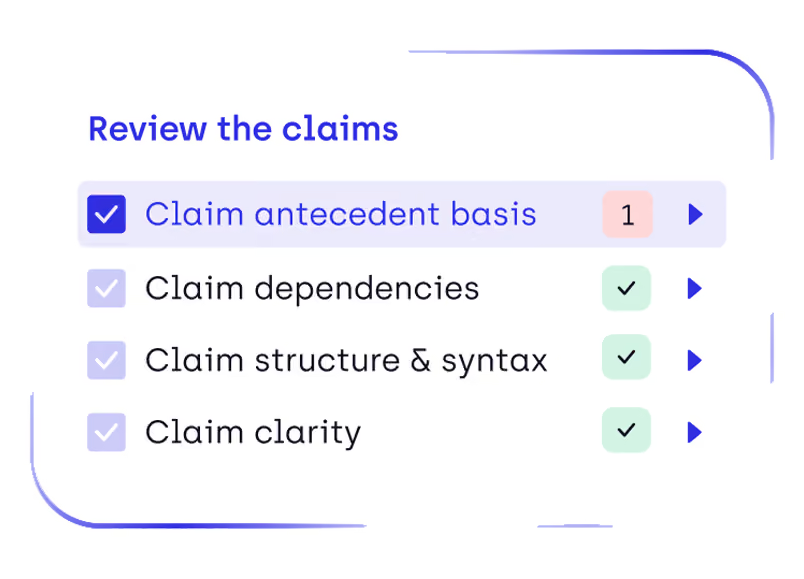
At the same time, workflows remain document-centric. Office actions are still processed as static documents rather than as structured decision problems. Practitioners must reconstruct relationships between claims, prior art, and legal arguments each time—even when similar patterns have been encountered before.
The cognitive burden thus becomes repetition without accumulation.
What became clear to me is that the deeper issue is actually architecture, not inefficiency. Patent workflows remain document-centric, while effective decision-making requires integrated, system-level intelligence.
From Fragmented Tools to Integrated Systems
The transition required is less about adopting more AI tools and more about integrating AI into the workflow architecture itself. The central question becomes, “Where should intelligence live, and how should it flow?”
In traditional practice, intelligence resides in documents and individual practitioners. Knowledge is created, but it is not persistently structured or systematically reused across the lifecycle.
In AI-native workflows, intelligence is embedded directly into the workflow layer. Search, drafting, prosecution, and portfolio strategy are no longer isolated steps. Instead, they function as components of a continuous system, where insights generated at one stage inform decisions at every subsequent stage.
From my experience, this shift can be understood through three fundamental transitions:
- Tools → Integrated systems
- Documents → Decision flows
- Isolated steps → Continuous lifecycle intelligence
In this model, the role of the practitioner evolves. Rather than repeatedly reconstructing context, we operate at a higher level: guiding strategy, interpreting legal implications, and making judgment calls within a system that continuously surfaces structured insight.
What I Learned from Integrating AI into My Patent Workflows
Through hands-on evaluation and real-world application of AI tools in patent workflows, several key lessons became clear to me:
1. Integration Matters More Than Capability
Even the most advanced AI tools deliver limited value when used in isolation. The real impact comes from how those tools are connected across the workflow.
2. Continuity of Reasoning is the Missing Layer
Traditional workflows require practitioners to repeatedly reconstruct context. AI-native systems allow that context to persist by linking search insights, claim structure, and prosecution strategy into a continuous chain of reasoning.
3. AI Shifts Where Expertise is Applied
Rather than spending time reconstructing analysis, practitioners can focus on higher-level strategic decisions such as claim scope, risk positioning, and portfolio direction.
4. Workflow Design Becomes a Competitive Advantage
The differentiator now goes beyond legal expertise or technical knowledge. It is in how effectively intelligence is structured, reused, and integrated across the lifecycle.
What Changes When Workflows Are Integrated?
In my evaluation and testing of AI-powered IP intelligence solutions such as DeepIP, I found that the real value of AI does not come from any single capability, but from how multiple modules—search, drafting, office action analysis, and portfolio intelligence—are connected into a unified workflow.
When these capabilities are integrated, something fundamentally changes:
- Prior art insights can directly inform claim structure
- Drafting decisions can be made with immediate visibility into prior art constraints
- Office action responses can be developed within the context of the original drafting logic
- Portfolio analytics can reflect both upstream design decisions and downstream prosecution outcomes
What I observed is that insights begin to persist across stages, something that is nearly impossible in traditional document-centric workflows.
While efficiency is a clear gain, the strongest success factor becomes continuity of reasoning.
Portfolio Intelligence in Practice
In one of my analyses of patent portfolios related to OpenAI technologies, I used the DeepIP portfolio intelligence module to move beyond individual patent review and instead construct a structured, portfolio-level understanding of how claims, technologies, and legal outcomes interact over time.
The portfolio itself (comprising over ninety patents consolidated into approximately thirty invention families) revealed something important: it was not a collection of isolated filings, but a coherent, vertically integrated architecture spanning runtime orchestration, multimodal integration, agent coordination, memory systems, and tool invocation layers.
Rather than reviewing patents in isolation, I was able to operate at the level of architectural systems and interdependent families. In practice, this meant I could:
- Map technology clusters aligned with core architectural layers (e.g., orchestration, embedding, multimodal integration)
- Analyze claim coverage across these layers to understand how control points were distributed
- Identify citation-based influence patterns and cross-family dependencies
- Evaluate how similar claims performed under examination and potential post-grant challenges
What emerged was not just a clearer picture of the portfolio, but a fundamentally different way of thinking about patent value.
I observed that the portfolio naturally segmented into survivability tiers. A subset of families, roughly corresponding to core platform control layers, demonstrated high structural resilience under eligibility and obviousness stress. Other families showed more variable survivability, often tied to incremental or application-layer innovations.
This distinction was critical It enabled a shift from treating all patents equally to survivability-weighted decision-making:
- High-resilience families became candidates for concentrated continuation investment and strategic expansion
- More variable families could be selectively reinforced or pruned based on modeled risk and strategic relevance
What I found particularly valuable was the ability to identify continuation opportunities and gaps in claim coverage much earlier than would be possible through manual review alone. Instead of reacting to office actions or litigation risk after the fact, I could proactively evaluate:
- Where additional claim scope was needed to reinforce architectural control points
- How continuation strategies could hedge against doctrinal uncertainty
- Which families could serve as anchors for future licensing or enforcement
This enabled more forward-looking decisions: where to file next, how to adjust claim scope, and how to align portfolio structure with product architecture and competitive positioning.
Equally important was the shift in how governance itself operates. By linking prosecution history, citation networks, and external legal signals (such as PTAB and Federal Circuit trends), continuous recalibration of portfolio risk and opportunity can be provided. This reduced what I would describe as governance latency—the delay between external legal or competitive changes and internal strategic response.
In this context, portfolio management moves from a retrospective reporting function to a continuous, adaptive decision system, integrating survivability modeling, architectural dependency mapping, continuation strategy, and capital allocation—all into a unified framework.
More broadly, this experience reinforced a key insight: In AI-era portfolios, patents are not just legal assets—they are components of adaptive strategic infrastructure.
And managing that infrastructure requires more than reviewing documents. It requires integrated, AI-native portfolio intelligence.
Integrating Search and Drafting
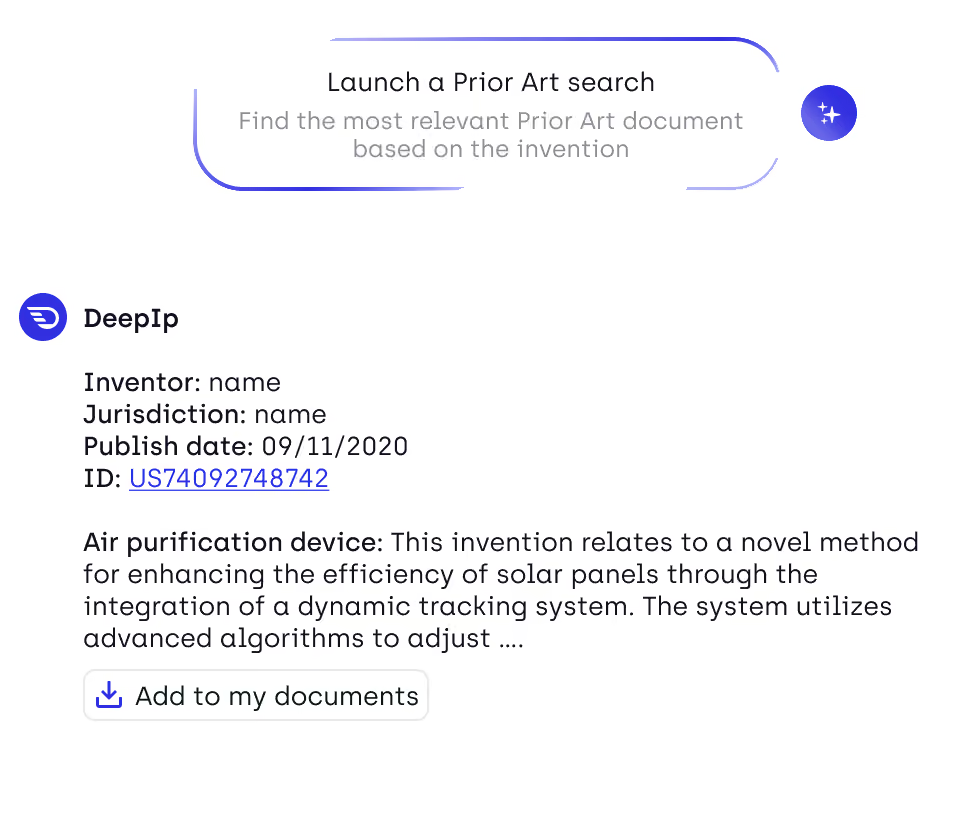
In another case, I worked through a workflow re-engineering exercise using patents related to Perplexity technologies, focusing on integrating prior art discovery and drafting into a unified process using multiple DeepIP modules within an AI-native workflow architecture.
This was not just a tooling exercise—it was driven by a broader structural issue I observed during the analysis. As the Perplexity platform rapidly expanded across enterprise offerings, API infrastructure, browser-native environments, and OEM integrations, the patent workflow remained anchored in a traditional, sequential model. This created a form of workflow-architecture misalignment, where patent filings reflected earlier product states rather than emerging platform control layers.
At the core of this misalignment was a familiar pattern: Traditionally, prior art search is conducted as a separate step. Results are reviewed, summarized, and then manually translated into drafting decisions. This separation assumes relatively stable technical boundaries and slower innovation cycles—assumptions that no longer hold in AI-native environments.
In practice, what I observed was that this separation introduces structural friction:
- Insights discovered during search are only partially reflected in claim structure
- Claim design often proceeds without full visibility into prior-art density and survivability risk
- The same reasoning must be reconstructed later during prosecution or invalidity analysis
In the Perplexity case, this problem was amplified by what I describe as portfolio-platform drift—where the patent asset base lags behind the evolving business architecture.
To address this, I re-engineered the workflow by integrating prior art intelligence directly into the drafting process.
Using DeepIP’s patentability, freedom-to-operate (FTO), drafting and office action modules, I structured a workflow where search and drafting operate as a continuous, co-evolving process rather than discrete steps.
In practice, this allowed me to:
- Structure prior art insights around key claim elements and architectural control points
- Iteratively refine claim scope in real time based on prior-art density and defensibility considerations
- Evaluate alternative claim strategies during drafting, rather than deferring these decisions to prosecution
- Identify specification gaps early, particularly in areas tied to emerging expansion vectors such as API orchestration and enterprise control layers
What became clear during this process is that the traditional separation between search and drafting is both inefficient and architecturally misaligned with how AI systems evolve.
When these steps are integrated, drafting becomes a dynamic, feedback-driven process. Prior art insights are no longer static inputs. They become active constraints and design signals that shape claim architecture in real time. Drafting decisions are no longer made in isolation, but continuously informed by survivability modeling, competitive density, and expansion priorities.
This integration also enables a deeper shift. Search is no longer a front-end validation step. It becomes part of a continuous intelligence loop embedded across the lifecycle:
Search → Drafting → Prosecution → Refinement
Each stage informs the next—and, critically, feeds back into earlier stages.
In the Perplexity case, this loop was further reinforced by integrating patent intelligence into broader governance architecture. Insights from drafting informed continuation strategy. Prosecution outcomes fed back into claim design standards. Competitive landscape monitoring reshaped future filing priorities.
The result is a fundamentally different operating model—one in which:
- Drafting aligns with real-time intelligence
- Prosecution reflects predictive risk modeling
- Portfolio expansion tracks business architecture evolution
More broadly, this experience reinforced a key insight: In AI-native environments, patent workflow cannot remain sequential. It must become adaptive, integrated, and continuously recalibrating.
And that transformation begins by breaking the artificial boundary between search and drafting.
What it Means for Patent Practitioners
For practitioners and organizations, the implications are immediate.
- Focus on integration, not individual tools: The key question is not what a tool can do, but how it connects to the broader workflow.
- Ensure continuity across lifecycle stages: Search, drafting, prosecution, and portfolio strategy should not operate independently. Insights must persist and propagate across the lifecycle.
- Prioritize high-impact integration points: Office action analysis, drafting workflows, and portfolio intelligence are areas where integration delivers immediate value.
- Build a shared intelligence layer: Organizations should move toward systems where knowledge accumulates over time, rather than being recreated for each task.
- Align AI with practitioner decision-making: AI should support structured reasoning and strategic judgment, not replace it.
From Documents to Systems
The most important shift underway is conceptual. Patent practice is no longer about producing documents. It is about managing systems—dynamic, interconnected structures that evolve with technology, law, and competition.
AI is not the differentiator by itself. The differentiator is how intelligence is integrated into the workflow. This is the foundation of an AI-native patent practice—an approach grounded not just in theory, but in real-world application across patent workflows.
And in that future, competitive advantage will not come from simply adopting AI tools. It will come from building better-integrated systems for patent practice.
FAQ: AI-Native Patent Practice

What is an AI-native patent practice?
AI-native patent practice is a model where artificial intelligence is embedded directly into patent workflows, enabling continuous intelligence across search, drafting, prosecution, and portfolio strategy rather than treating each step as a separate process.
In this approach, insights persist across the lifecycle instead of being recreated at each stage.
Why are traditional patent workflows no longer effective?
Traditional patent workflows are no longer effective because they are fragmented, document-centric, and do not scale with modern complexity. Practitioners must repeatedly reconstruct context across disconnected tools, increasing cognitive load and limiting efficiency as portfolios and prior art datasets grow.
How does AI improve patent workflows?
AI improves patent workflows by connecting insights across lifecycle stages, reducing repetitive analysis, and enabling real-time decision-making. The greatest impact comes from integrating AI across workflows—not using isolated tools—so that search, drafting, and prosecution continuously inform each other.
What is lifecycle intelligence in patent workflows?
Lifecycle intelligence is the ability to link insights from invention disclosure, prior art search, drafting, prosecution, and portfolio management into a unified system. This allows decisions made at one stage to inform all subsequent stages, improving consistency, efficiency, and strategic outcomes.
Why is integration more important than AI tools in patent practice?
Integration is more important than individual AI tools because isolated tools create isolated insights. The real value of AI comes from enabling intelligence to flow across the entire workflow—connecting search, drafting, prosecution, and portfolio strategy into a continuous system.
How does AI change the role of patent practitioners?
AI shifts patent practitioners from performing repetitive analysis to making higher-level strategic decisions. Practitioners increasingly focus on claim design, risk assessment, and portfolio strategy while AI supports structured reasoning and information synthesis.
What are the biggest challenges in modern patent workflows?
The biggest challenges include workflow fragmentation, lack of continuity between lifecycle stages, document-centric processes, and increasing cognitive burden. These challenges prevent patent practice from scaling effectively with growing technical complexity and portfolio size.
What are the benefits of integrated patent workflows?
Integrated patent workflows enable continuous reasoning across lifecycle stages, better alignment between drafting and prosecution, and improved portfolio-level decision-making. They also reduce duplication of work and allow knowledge to accumulate over time.
How can IP teams start adopting AI in patent workflows?
IP teams should start by integrating AI into existing workflows rather than adding standalone tools. The most effective approach is to focus on high-impact areas such as drafting and office action analysis, while building systems where insights persist across tasks and projects.
What is the future of patent practice?
The future of patent practice is system-driven and intelligence-integrated rather than document-driven. Competitive advantage will come from how effectively workflows are designed to connect data, reasoning, and decision-making across the patent lifecycle.
.avif)