How AI Is Reshaping Patent Law Firm Strategy: Insights from Greenberg Traurig, IPWatchdog & DeepIP
.png)

The question facing IP law firm leadership is no longer whether to adopt artificial intelligence—it's how quickly they can do so before their competitors pull ahead. That was the central message to emerge from a fireside chat hosted by Gene Quinn, Founder of IPWatchdog, featuring Barry Schindler, Co-Chair of Greenberg Traurig's Global Patents and Innovation Strategies Group, and François-Xavier Leduc, Co-Founder & CEO of DeepIP.
The conversation covered the full sweep of AI's impact on patent practice: from claim drafting and office action strategy to law firm business models, data security, and what Schindler calls the "arms race" now underway across the IP industry.
What Is Driving AI Adoption in Patent Law Right Now?
The speed of change has been the defining feature of this moment. As Leduc framed it, 2023 was a year of skepticism: firms watched generative AI with curiosity but kept their distance. 2024 marked a shift, with large firms beginning to adopt AI at scale. By early 2025, that had become something closer to a rush—and by 2026, that rush has become the new baseline.
"What we're seeing now is almost a rush to get equipped," Leduc said. "Because I think everyone now understands that generative AI is here to stay."
That prediction has held. As of early 2026, AI adoption across IP practices is no longer a leading-edge decision, it's table stakes. The numbers from DeepIP's own platform reflect that acceleration: general usage has grown seven-fold year over year, with a 300% increase in new matters created in 2025 vs. 2024.
For Schindler—who has practiced patent law for over 30 years, holds a registration number in the 32,000s, and teaches a course called The Art of Claim Drafting at Stanford—the significance of this moment can only be understood against the long arc of the profession's evolution.
"When I first started, we all remember the tri-folders," he said, describing a time when patent prosecutors debated which side of a physical folder to place client correspondence. "That was my life. That was the life of a patent prosecutor at the beginning. It's amazing what we're going to talk about today and how far we've come."
Is AI Replacing Patent Attorneys? The Augmentation Argument
One of the most persistent concerns among practitioners is whether AI tools will ultimately displace the attorneys who use them. The answer from both Schindler and Leduc is an unequivocal no—but the reasoning matters.
The argument is not simply reassurance. It's structural. Schindler, who sits on the New Jersey Supreme Court Committee on Generative AI, is emphatic that claim drafting—the intellectual and creative core of patent prosecution—cannot be automated.
"The reason I'm bringing this up is that I think generative AI will be a tool, but it will not at all change how we draft claims," he said. "Will it help us draft claims? Yes. But it's really going to begin at the art of claim drafting, and that's what I want everyone to focus on."
In Schindler's model, AI handles what he calls the "grunt work"—expanding specifications, checking for consistency across claims, covering variations—freeing senior attorneys to invest more time in the high-value work that actually determines a patent's strength. Leduc described this as AI acting as an "exoskeleton": attorneys can work up to two hours more per day on substantive patent drafting, producing higher-quality applications in the same time frame.
The practical benefit, according to attorneys using the platform, is not just efficiency. It's the return of something that gets lost when practitioners are managing volume under fixed-fee pressure: the pleasure of the work itself.
"They save time, which they usually reinvest, at least partially, into delivering a much better-quality final product," Leduc said of DeepIP's users.
The AI Arms Race in Patent Law: Why Waiting Is Not a Neutral Choice
Schindler's most urgent message was directed at firms that are still evaluating whether to adopt AI. He described the current competitive landscape as an "arms race"—and argued that remaining on the sidelines is itself a strategic decision with consequences.
"Your competitors are using generative AI," he said. "And it's not just competitors. It's the VCs looking to invest in your company. It's the FTOs of your competitors. Everybody's going to be using, if not already using, some type of generative AI to test your claims, your application, or your granted patent, to determine what is wrong."
The threat is not hypothetical. Venture capitalists and freedom-to-operate (FTO) teams are already running patents through generative AI to identify claim weaknesses before investment decisions are made. Firms that are not using AI to stress-test their own applications are, in effect, leaving that analysis to opposing parties.
The USPTO dimension compounds the urgency. Patent offices globally are developing and deploying their own AI tools for prior art search and examination. As Schindler put it: "If you're drafting patents without AI assistance, you're submitting applications that will be examined against AI-assisted searches."
Leduc agreed: "In the near future, we're going to see firms using AI to draft stronger patents, while patent offices use AI to challenge those patents. This means that AI is not just an efficiency tool—it's a competitive advantage."
How AI Changes the Patent Law Business Model
The financial model of patent prosecution, particularly the prevalence of fixed-fee arrangements, has long created structural pressure on quality. Firms working within fixed fees routinely push drafting work to lower-cost associates. The application gets done on budget, but the quality of the specification and the claim coverage may suffer.
Schindler acknowledged the tension directly: "The uncomfortable thing is that a lot of patent prosecution is done on a fixed fee. And what happens many times is that, to meet a fixed fee, firms push work down to lower-fee associates. Which makes sense, but sometimes that means the quality suffers."
AI changes this calculus. When AI handles the structural and repetitive elements of drafting—organizing the specification, covering claim variations, generating supporting language—both senior and junior attorneys can contribute at a higher level. Senior attorneys spend more time on claims strategy. Junior associates produce better first drafts.
The result, as DeepIP's clients report, shows up not just in efficiency but in outcomes: stronger applications, more compact prosecution, and reduced need for requests for continued examination (RCEs). Attorneys using the platform report handling peak workloads with less stress—which Leduc noted also has implications for talent retention, a persistent challenge for IP practices.
AI for Office Action Responses: Leveling the Playing Field with the USPTO
Beyond initial drafting, AI is increasingly being applied to one of the most time-intensive tasks in patent prosecution: responding to USPTO office actions.
USPTO examiners are already using AI-driven search tools to locate prior art. That means the search that produced a §102 or §103 rejection may have surfaced references that a traditional manual search would have missed. Responding effectively requires a proportionate level of analytical depth.
Schindler framed this plainly: "If you're responding to an office action without using AI, you are already at a disadvantage."
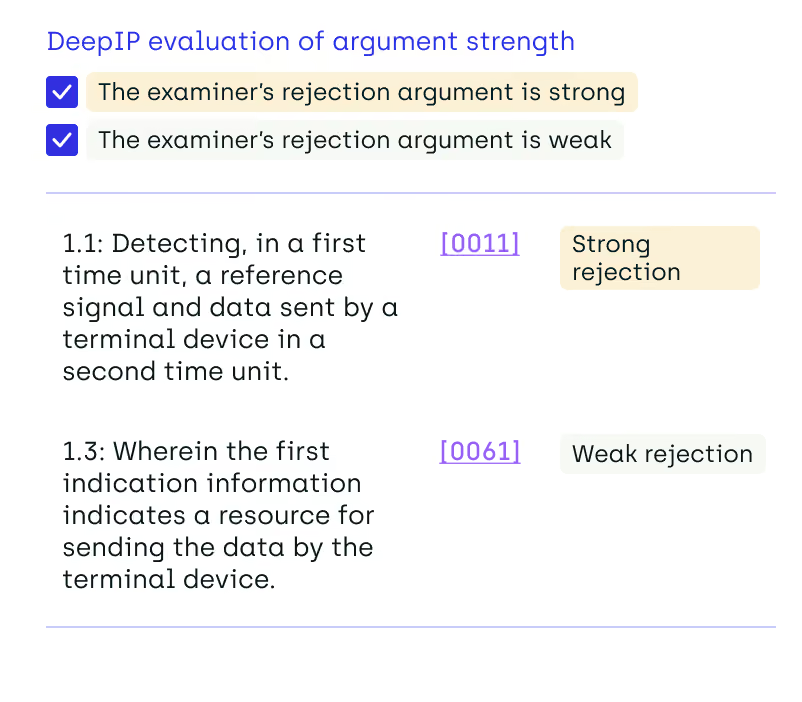
DeepIP's patent prosecution module addresses this directly. It's designed to accelerate examiner rejection analysis, identify the specific grounds and prior art references being applied, and help attorneys generate targeted arguments and claim amendments. The aim is not to automate the response, but to compress the analytical phase so practitioners can focus on strategy.
Quinn, who founded IPWatchdog in 1999 and is widely regarded as one of the most influential voices in US patent law, sees AI-assisted prosecution analysis as the logical next step in a field already accustomed to tools that extend attorney capability. He pointed to AI's coming role as a pre-filing reviewer—capable of analyzing a complete draft for §101, §102, and §103 risks before submission.
Data Security and Confidentiality: The Questions Every Firm Must Ask
For many law firms, the barrier to AI adoption is not strategic skepticism but concern about data security. Patent applications contain some of the most commercially sensitive information a company produces. Any tool that processes that information must meet an exceptionally high bar for confidentiality.
Schindler noted that when his firm evaluated AI tools, security was among the first questions asked—and that not all tools on the market meet the standard. Some AI products use client data for model training. Some have demonstrated leakage vulnerabilities.
DeepIP's architecture was designed to address these concerns at the infrastructure level, not as an afterthought. The platform holds ISO 27001, ISO 42001, and SOC 2 Type 2 certifications and is built on what Leduc described as a stateless API model: no client data is retained, stored, or used for training purposes. All data is encrypted at rest and in transit, with logical and physical data segregation across clients.
"We built DeepIP with confidentiality at its core," Leduc explained. The platform operates within Azure's private cloud infrastructure, and Microsoft has granted DeepIP an exclusive monitoring exemption—meaning no external party, including Microsoft itself, can access client data.
For large firms that require an additional layer of control, DeepIP can be deployed in a private cloud environment, giving the firm direct ownership over its data architecture.
What Should Law Firm Leadership Do Now?
The consensus from Schindler, Quinn, and Leduc is that AI adoption in patent practice has passed the point where it's a question of preference or readiness. It's now a question of timing and execution.
Schindler summarized the shift in framing: "The question is no longer: Should I use AI? The question is: How quickly can I start using AI to stay competitive?"
For law firm partners evaluating this decision, the practical starting point is understanding where AI delivers the clearest near-term value: patent drafting, office action analysis, claim consistency review, and specification generation. These are areas where AI augments existing workflows without requiring significant process redesign—and where the return on time invested is measurable from the first application.
Leduc's closing message was addressed directly to practitioners who may still be weighing the decision: "There is no risk of replacement with AI, but there is an urgency to adopt these tools."
And Quinn, who has covered more cycles of change in IP practice than most, offered a straightforward observation: "Every time I see these AI demos, the tools do more, and more, and more...I think once you see the benefits, you won't want to go back to drafting the old way."
FAQ: AI in Patent Law

Is AI replacing patent attorneys?
No. The expert consensus — including from practitioners with decades of experience — is that AI augments rather than replaces patent attorneys. AI handles repetitive and structural drafting tasks, freeing attorneys to focus on high-value work like claim strategy and complex prosecution decisions. The core skills that define excellent patent prosecution — understanding an invention deeply, drafting claims that truly cover it, and arguing against rejections — remain the domain of experienced practitioners.
How are law firms using AI for patent drafting?
Law firms are using AI tools to accelerate specification drafting, generate claim variations, check for consistency across application sections, and produce structured first drafts from invention disclosures. Senior attorneys use AI to reduce time on administrative drafting tasks and invest more time in claims. Junior associates use AI to produce higher-quality first drafts, partially offsetting the quality risk inherent in fixed-fee prosecution models.
What AI tools is the USPTO using?
The USPTO has been developing and deploying AI-assisted tools for prior art search and examination support. The specific tools are subject to ongoing development, but the practical implication for practitioners is significant: examinations are increasingly being conducted with AI-enhanced search capability, which changes the standard of rigor needed in application drafting and office action responses.
How does AI help with office action responses?
AI tools designed for office action response — such as DeepIP's office action module — can analyze examiner rejections, identify the specific prior art references being applied, map those references against claim language, and help generate targeted arguments and amendments. This compresses the analytical phase of the response process, allowing attorneys to focus more time on prosecution strategy.
Is it safe to use AI tools for confidential patent applications?
It depends on the tool. Law firms should evaluate any AI tool against criteria including: whether client data is used to train the model, whether data is retained after sessions, encryption standards, and certification status. Platforms like DeepIP are ISO 27001 and SOC 2 Type 2 certified and operate on a stateless architecture — meaning no client data is stored or reused.
What is the AI arms race in patent law?
The term, popularized in IP legal circles, refers to the accelerating adoption of AI tools across all parties involved in the patent ecosystem — applicants, law firms, corporate IP departments, investors conducting freedom-to-operate analysis, and patent offices themselves. Because all sides are using AI, firms that do not adopt AI-assisted tools are increasingly at a disadvantage when their applications are examined, challenged, or evaluated by parties using more sophisticated analysis tools.
.avif)