
Find, Complete and Triage Every Invention
Surface the inventions hidden in roadmaps, reports and lab notes, turn them into complete disclosures without weeks of email, and decide for each one: file, protect another way, or ask the inventor.
Trusted by 500+ law firms and in‑house IP teams








[0001]
Definition
What Is an Invention Disclosure?
An invention disclosure is the confidential document in which inventors describe an invention to their IP team or patent attorney: the problem it solves, how it works, its variants, its advantages and the prior work they know. It is the basis for deciding whether to file and for drafting the patent application.
Invention harvesting is the step before: actively finding inventions in what R&D produces, because many are never disclosed. What engineers see as routine is often what’s patentable, and forms feel like a chore, so valuable ideas stay in slides and reports.
Also called
Invention disclosure form (IDF), record of invention, invention harvesting or mining
Who uses it
R&D teams and inventors, in‑house IP teams, patent attorneys, tech‑transfer offices
[0002]
Harvest
Find the Inventions Nobody Has Disclosed
Many inventions never reach the IP team: engineers rarely submit ideas, and the ones worth protecting sit in roadmaps, project reports and demo decks. DeepIP reads what R&D already produces, surfaces candidate inventions with alternative embodiments, and checks each one against what you have already disclosed or filed.
Candidates surfaced from roadmaps, reports, notes and calls
Alternative embodiments suggested for each
Checked against your own disclosures and filings
[0003]
Complete
Complete Disclosures, Without the Email Chain
Inventors think in slides, code and experiments, not legal forms. DeepIP structures whatever they produce into your invention disclosure form, links every section to its source, and turns each gap into a ranked technical question you send to the inventor.
Any input, structured into your IDF template
Every section traced to its source
Gaps as ranked technical questions for inventors
[0004]
Triage
Triage at Volume: File, Protect Otherwise, or Ask
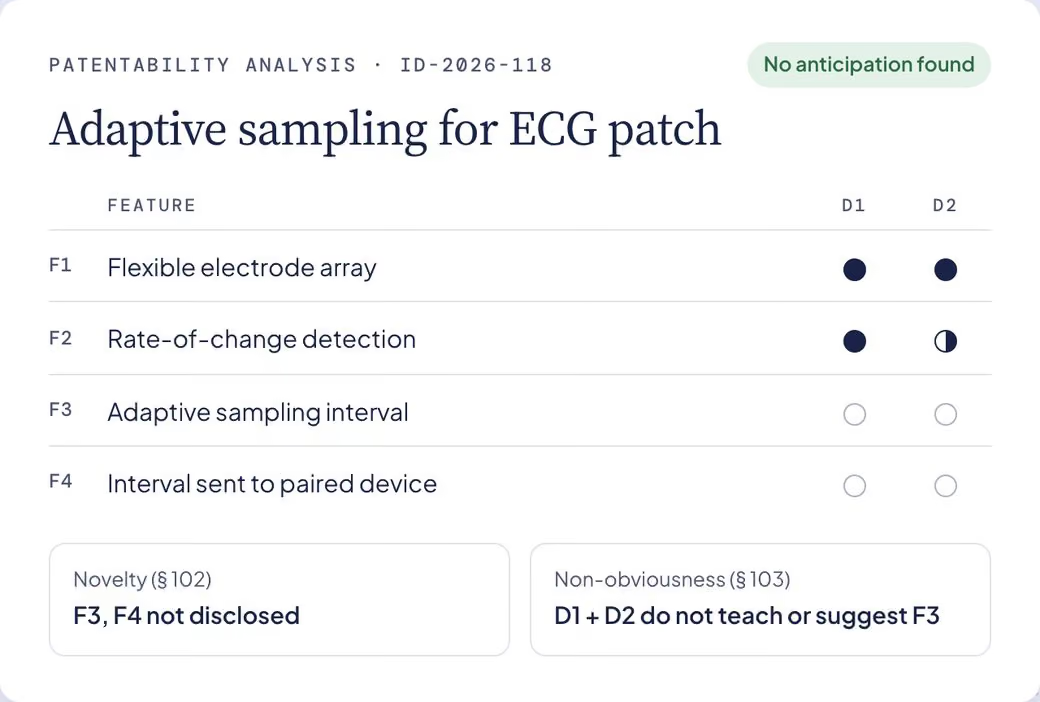
When a few attorneys face hundreds of disclosures a year, the bottleneck is deciding. DeepIP reads each disclosure against the prior art and your own portfolio, flags duplicates, and lays out the options for the attorney to choose, with reasons: file, keep as a trade secret, publish defensively, or go back to the inventor.
Novelty read and portfolio overlap for every disclosure
Patent, trade secret or defensive publication, with reasons
Each inventor’s contribution recorded
[0005]
Who does what
Inventors Describe, Attorneys Decide
Inventors describe what they built and tested. Whether it is new and inventive is the attorney’s assessment.
Describe What You Built and Tested
Assess It, Then Decide the Route
AI-generated suggestions are drafts for professional use only.
What teams say about DeepIP
In-house IP team
“During our trial period, when we were testing different tools, we observed an approximately 20% improvement in efficiency for drafting and prosecution.”
IP law firm
“DeepIP excels in terms of its structured multi-step model for analyzing materials and providing quoted citations linked to their sources. Whether drafting applications or Responses, it analyzes complex material quickly and accurately and provides valuable suggestions for claims, application editing, amendments, arguments, and much more, and you can access all of that from a seamless MS Word extension.”

IP law firm
“The tool is highly customizable. It really provides the drafting attorney or the prosecution attorney with tremendous discretion on how to use it.”
See it on a disclosure like yours.
Enterprise‑Grade Security and Confidentiality
Unpublished inventions are your most sensitive assets. They never train a model and are hosted in the US or the EU, your choice.
[0007]
Results
Measurable Results at Scale
Platform-wide totals.
[0008]
FAQ
Invention Disclosure and Harvesting: Common Questions
How do you find inventions that are never disclosed?
By reading what R&D already produces, such as roadmaps, project reports, lab notes and design reviews, and surfacing candidate inventions for inventors to confirm, rather than waiting for forms to be submitted.
What is the invention disclosure process?
Inventors describe the invention to their IP team, usually on an invention disclosure form. The IP team or a patent attorney reviews it, asks for missing details, and decides whether to file a patent application, keep the invention as a trade secret, publish it defensively, or gather more information.
What should an invention disclosure include?
The problem solved, how the invention works, variants and alternatives, advantages supported by data, prior work the inventors know, and each person’s contribution. Missing variants and data are the most common gaps.
Should inventors say what is inventive in a disclosure?
Many IP teams prefer that inventors describe their work rather than characterize novelty, because those statements can surface later in prosecution or litigation. DeepIP asks technical questions and leaves inventiveness to the attorney.
When should an invention be kept as a trade secret instead of patented?
Often when infringement would be hard to detect in a competitor’s product, such as a process or a material formulation, and when the invention can be kept confidential. The decision rests with the IP team.
What is a defensive publication?
A defensive publication is a deliberate public disclosure of an invention, made so that it becomes prior art and others cannot patent it later. It is one of the routes at the end of triage, next to filing and keeping the invention as a trade secret.
What is the difference between an invention disclosure and a patent application?
An invention disclosure is an internal, confidential record in which inventors describe an invention to their IP team. A patent application is the formal document filed with a patent office, which defines what is claimed and is typically published later. The disclosure is the starting point for deciding whether to file and for drafting the application.
Can DeepIP use our own invention disclosure form?
Yes. Disclosures can be structured into your organization’s own template or a standard DeepIP form.
Is the invention data used to train AI models?
No. Invention material stays confidential to your organization and is never used to train models.
Patent Drafting
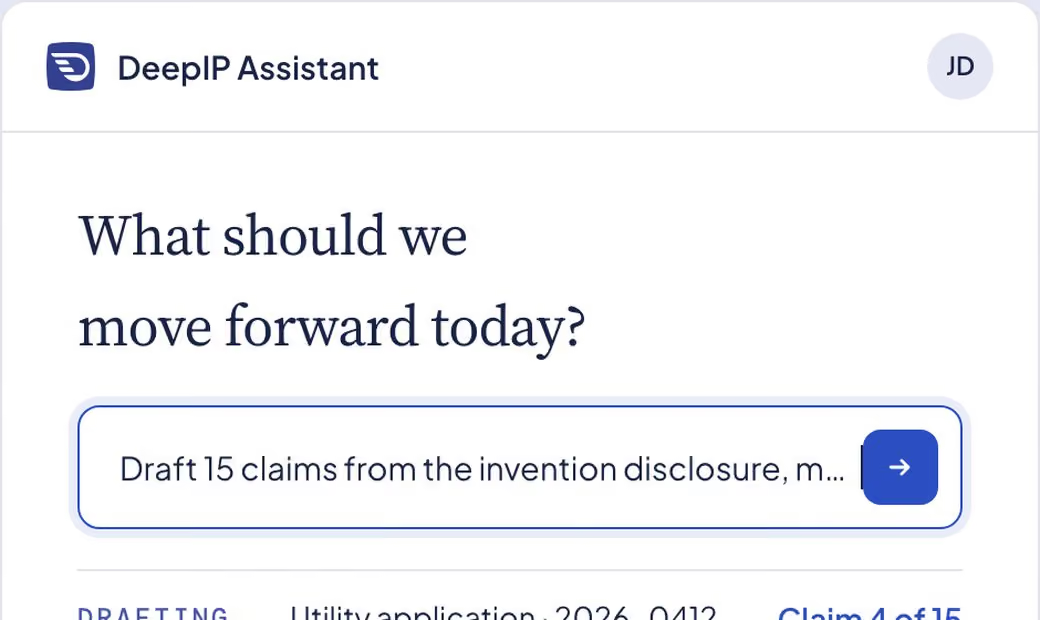
From invention disclosure to a filing‑ready application, written in your style.
Explore Patent Drafting
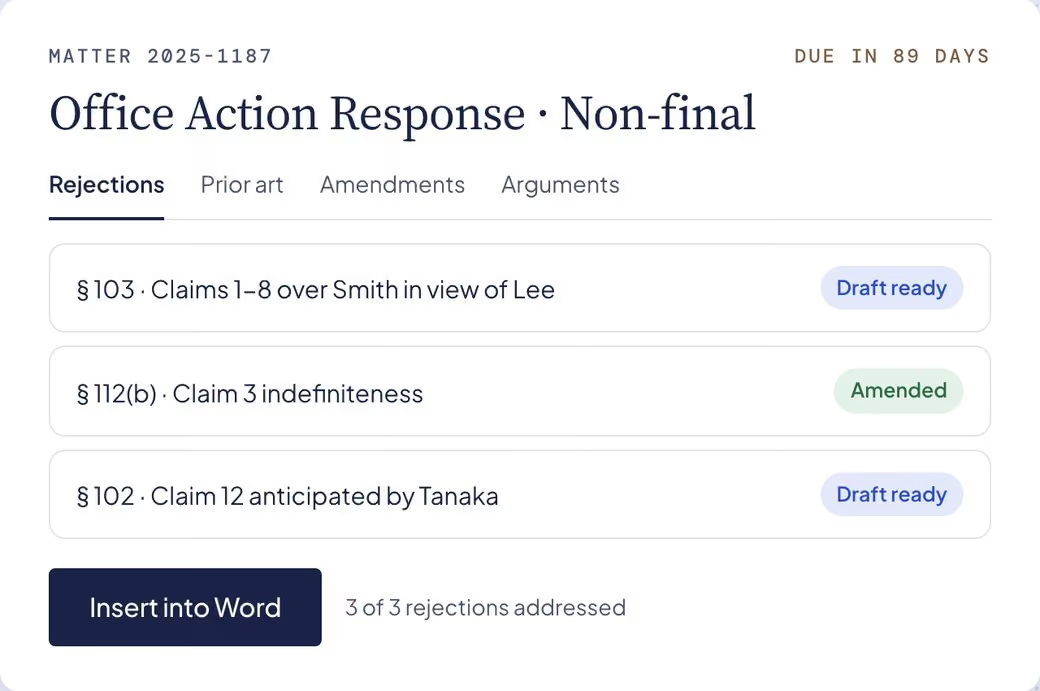
Office Actions
Respond to office actions with confidence, from the rejection to a filing‑ready response.
Explore Office Actions
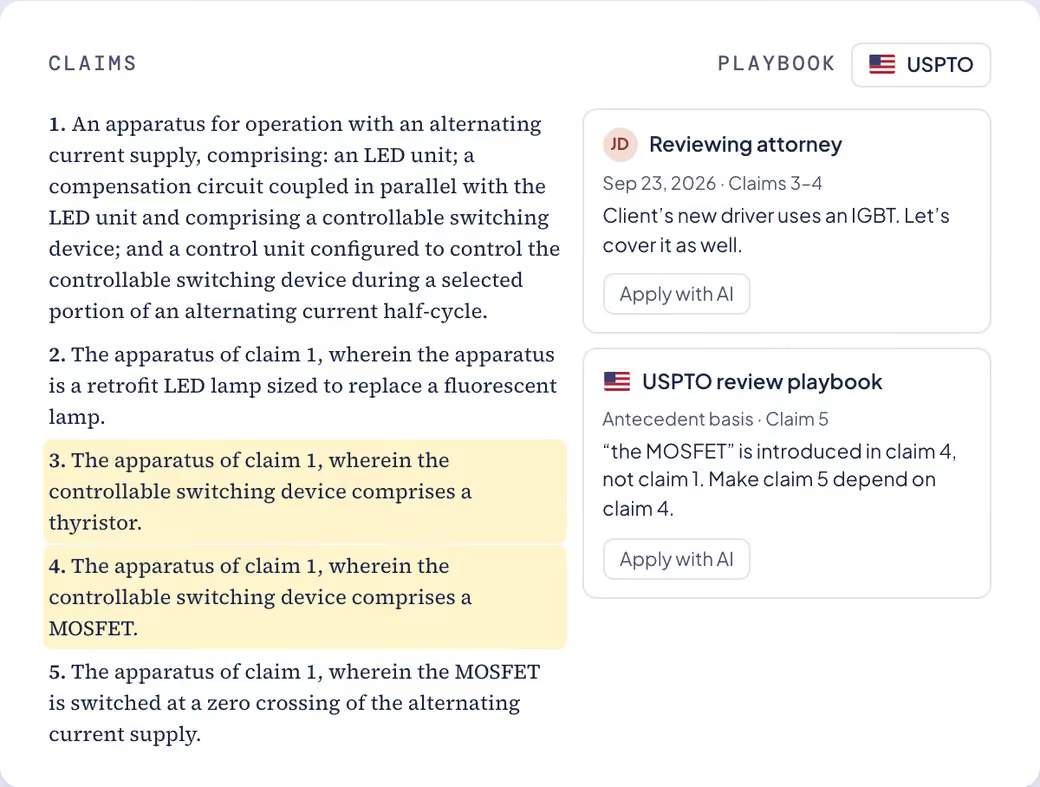
Integrations
Inside Word, connected to your DMS and the patent offices, with your systems as the source of truth.
Explore Integrations
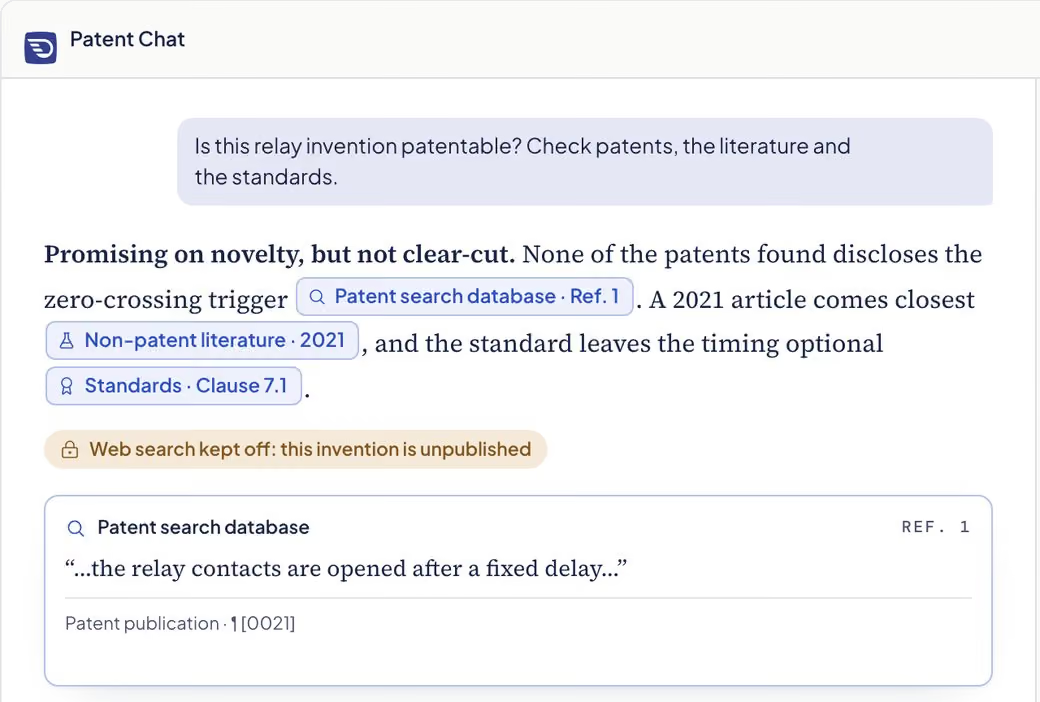
Knowledge & Sources
Patent answers with citations you can open, drawn only from the sources you switch on.
Explore Knowledge & Sources
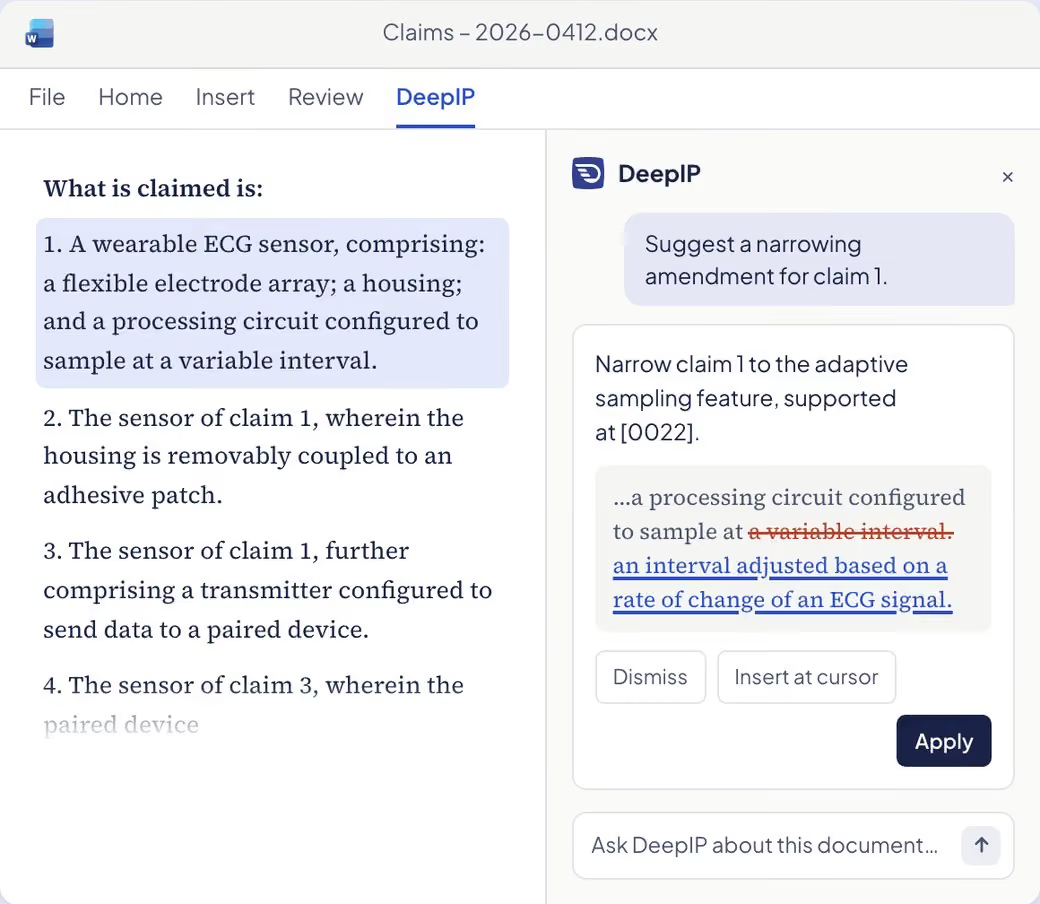
MCP & API
Connect Claude, ChatGPT or your own agents to patent data they can cite.
Explore MCP & API
Invention Disclosure
From roadmaps and lab notes to complete disclosures, with a suggested route for the attorney.
Explore Invention Disclosure