Ashwanth Sridhar on the AI Maturity Gap Holding Patent Teams Back

As a patent engineer turned patent manager, I see significant disruption emerging across traditional patent workflows. Having begun my career in the knowledge process outsourcing (KPO) industry with patent search and analytics, I grew comfortable with established processes, but they no longer feel relevant in today’s rapidly evolving tech era.
Starting with patent searches gave me a structured, linear workflow built around meticulous steps. Although systematic, the processes demanded intense manual effort, often becoming monotonous.
Throughout my experience with multiple search types including nullity and patent clearance searches, the methodology remained largely traditional to meet quality expectations. Each search method has its own needs: date restrictions for invalidity searches, legal status checks for freedom to operate (FTO) analyses, etc. Yet the fragmented approach has persisted unchanged.
Where Hybrid Workflows Normalize Inefficiencies
1. Fragmented Search Ecosystem:
Working across multiple disconnected databases with inconsistent coverage increases review time. Frequent switching between tools increases cognitive load and risk of missing prior art.
2. Search Inefficiencies:
Keyword and Boolean searches remain dominant despite obvious limitations; strategy becomes reactive and generic rather than insight-driven. Manual reporting, claim comparison, and invention disclosure drafting continue to slow teams
3. Automation Without Interpretation:
Semantic and prompt-based retrieval accelerates searches but can compromise depth. Workflows are shifting from keyword → free text → image search without strengthening analytical frameworks
Ultimately, this shift feels like AI tools are becoming more powerful, while workflows fail to evolve alongside them. These systems are trained for specific requirements but still lack human judgment and conceptual understanding. As a result, we have moved from traditional search toward hybrid AI-assisted models, but the maturity gap remains.
Challenges Demanding AI Transformation
Hybrid workflows must progress from manual, fragmented procedures to intelligent, scope-aware, strategy-driven systems. Refining search methods and surfacing more relevant results are critical for efficient prior art identification.
In my early days I used to review hundreds of patents across various scopes, which often led to fatigue. Hybrid models help retrieve relevant results using AI search and chat-based systems, but selecting the closest prior art still raises questions.
Introduction of an AI-based prior art search tool for R&D teams helped in featuring strong filters for narrowing results. Converting free text queries into claim elements is a promising feature.
However, as patent professionals, we still observe a clear gap between human expertise and tool capability. Knowledge graph generation seems beneficial but lacks domain depth, and its comprehensiveness is difficult to measure.
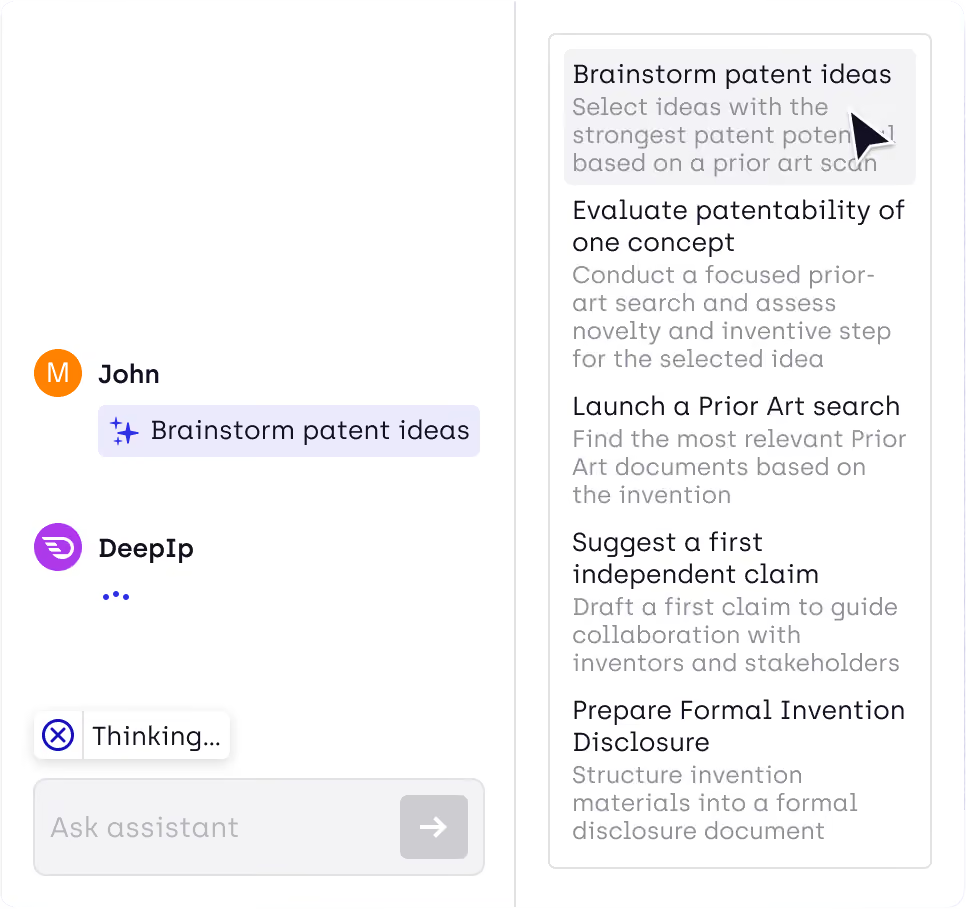
My role involves guiding inventors to shape ideas into patents effectively and with proper IP awareness. Conversational systems that help for differentiation at early stages are still a challenge to find. We need tools that allow us to fail fast and cheaply.
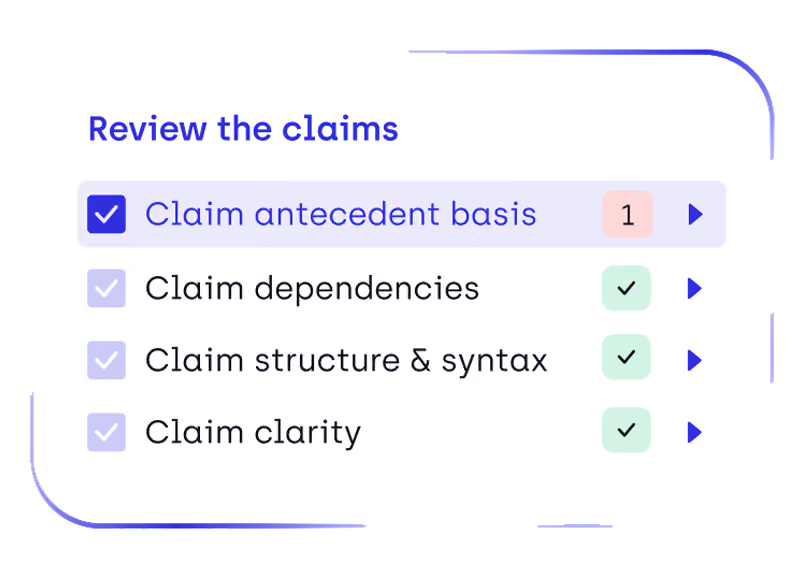
In patent clearance assessments, risk evaluation still relies on our attorneys because AI systems require a human in the loop to effectively perform this capability. What we need is dynamic claim comparison that adapts to evolving inputs like how patent engineers think.
During competitor monitoring, I’ve observed limitations in tagging precise technology clusters to specific product lines. Accurate clustering would strengthen decision-making and portfolio strategy, but today it still requires manual review, even when AI tools effectively perform tagging.
How AI Supports My Daily Work
When AI appeared years ago, it began transforming various industries; today it is reshaping the intellectual property landscape and has become a practical companion throughout the IP lifecycle.
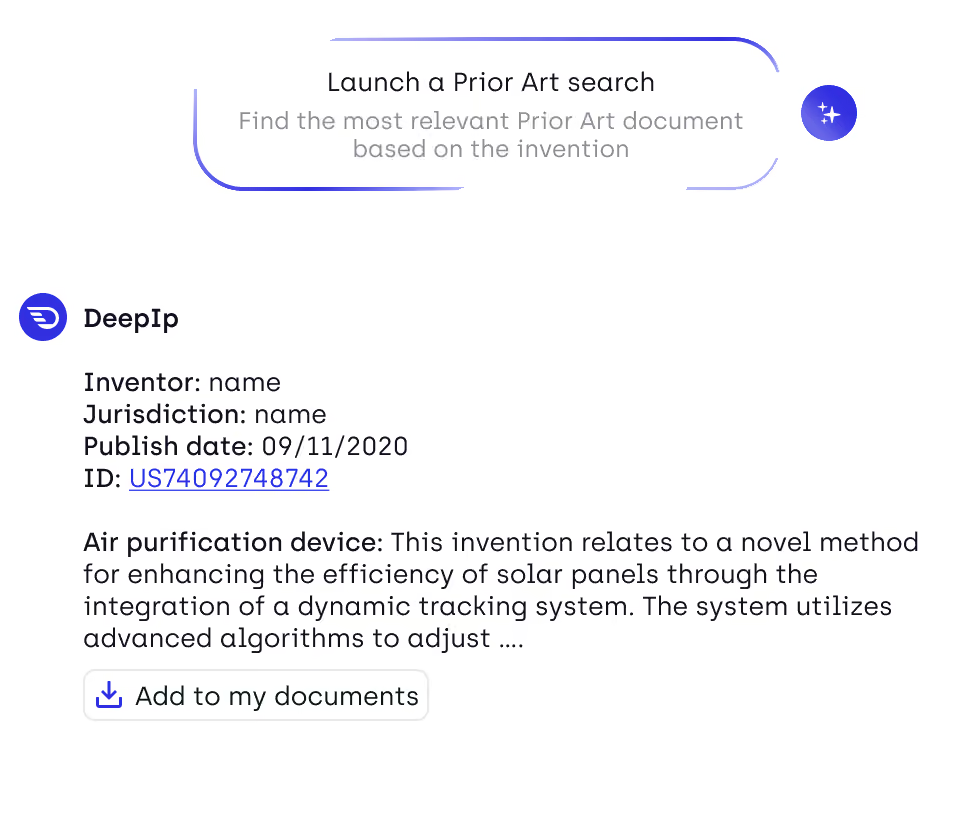
In my workflow, AI drastically reduces time at every step. Recently, while performing a prior art search for an invention disclosure, an AI tool reduced my effort by finding highly relevant results within minutes through an Agentic AI workflow.
Similarly, in nullity searches, strong prior arts surfaced quickly using specific semantic tags. However, claim assessment still requires manual work in my workspace. AI assists the search, but the value creation remains human-driven.
More areas where I’ve found value in patent AI:
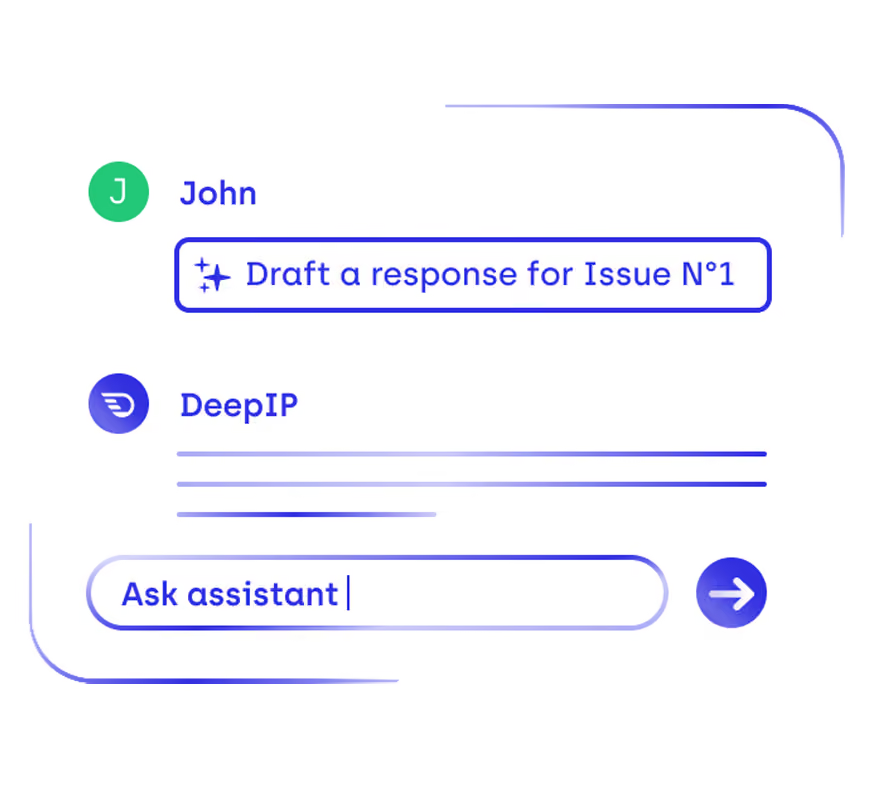
- Chat-based assistants in patent tools for quick clarifications and workflow navigation
- Text-to-claim generators converting raw ideas into structured claim language
- Smart AI search like document upload search yielding instant, high quality prior art sets
- Image-based search identifying relevant art beyond keywords and classification codes
- Agentic assistants integrated into our framework IP management coaches, strategy advisors, monitoring bots
Additionally, integration of multisignal competitor analysis within patent landscape using agentic approach gives me a consolidating scattered insights into meaningful intelligence to make business strategic decisions
Practical Lessons Other IP Teams Can Apply
Patent teams can benefit from:
- Adopting autonomous search enhancements, such as document-based AI search
- Using AI tools to support brainstorming and semantic understanding of inventions
- Collaborating with internal AI teams to build agentic frameworks for competitor monitoring
- Developing intelligence agents for competitive and industry forecasting
- Using AI-enabled systems to accelerate and refine FTO and novelty assessments
- Leveraging AI for realtime global patent activity monitoring
- Empowering developers with tools that improve invention disclosure quality through IP coaching
- Ensuring tools can handle edgecase claim interpretation and complex prior art contexts
Patent workflows are in a state of uncertainty. Instead of rigidly systematizing them, we must adopt models that are prepared for the future.
The future of patent workflows is not a simple technological upgrade, it is a structural redesign of how innovation is discovered, protected, and strategically strengthened.
FAQ: AI Maturity Gap in Patent Workflows

What is the AI maturity gap in patent workflows?
The AI maturity gap refers to the disconnect between how quickly AI tools are advancing and how slowly the workflows built around them are evolving. Patent teams are adopting more powerful AI capabilities—semantic search, agentic retrieval, image-based search—without restructuring the underlying processes to take full advantage of them.
Why do hybrid patent workflows persist despite their inefficiencies?
Hybrid workflows—combining traditional manual steps with AI-assisted tools—have become normalized because they meet quality expectations without requiring teams to redesign established processes. However, they often preserve inefficiencies such as fragmented database switching, reactive search strategies, and manual reporting that AI could otherwise eliminate.
What are the limitations of AI in patent clearance and FTO analysis?
AI can accelerate prior art retrieval and surface relevant results quickly, but risk evaluation in patent clearance and FTO analysis still requires human judgment. Dynamic claim comparison, legal status assessment, and final risk determinations need a qualified professional in the loop—AI assists the process but does not replace the expertise required to reach defensible conclusions.
How does AI support prior art search in practice?
AI tools reduce search time significantly through agentic workflows, semantic tagging, document-upload search, and image-based retrieval. These approaches surface relevant references that keyword and Boolean searches would miss. However, selecting the closest prior art and assessing its relevance to specific claim elements still requires human expertise.
What is agentic AI in the context of patent search?
Agentic AI refers to systems that autonomously explore, iterate, and reason through a search task rather than returning a static set of results. In patent search, agentic workflows can convert free-text invention disclosures into structured claim elements, run multi-step searches, and refine results based on evolving inputs—reducing the manual effort traditionally required at each stage.
What practical steps can patent teams take to close the AI maturity gap?
Teams can begin by adopting document-based AI search, using AI to support invention brainstorming and semantic understanding, building agentic frameworks for competitor monitoring, and leveraging AI for real-time global patent activity tracking. The goal is not to automate existing workflows but to redesign them around the capabilities AI now makes possible.
Why does competitor monitoring still require manual review even with AI tools?
Current AI tools can effectively tag technology clusters, but accurately mapping those clusters to specific competitor product lines still requires manual validation. The precision needed for strategic portfolio decisions—knowing exactly which patents threaten which products—goes beyond what automated tagging reliably delivers today.
What does the future of patent workflows look like?
The future is not a technological upgrade of existing processes but a structural redesign of how innovation is discovered, protected, and strategically managed. Patent workflows need to become intelligent, scope-aware, and strategy-driven—moving beyond fragmented, manual procedures toward systems that support IP professionals at every stage of the lifecycle.
.avif)