
How Corey Hawse at Nixon & Vanderhye Used DeepIP to Improve Efficiency and Increase Output for His Clients
Executive Summary
Corey Hawse has been drafting mechanical patent applications at Nixon & Vanderhye since 2012. Before joining the firm, he was a USPTO patent examiner in HVAC and heat exchange technologies. So, he knows what makes an application hold up under scrutiny, not just in theory, but from the other side of the desk.
His practice today spans patent drafting and prosecution across more than 15 countries, IP due diligence, and portfolio transactions. His global scale means every application has to survive examination in many foreign patent offices, not just the USPTO. A generic and unsophisticated description of the subject matter isn't an option when you're filing in the United States, Japan, Europe, and China.
Despite his strategic view of application drafting, he found too much time spent on mechanistic tasks, like converting claims to summary paragraphs, writing brief descriptions for a hundred figures, and double-checking that every claim has antecedent basis in the detailed description, didn’t translate to value for the client commensurate with the cost.
As Hawse puts it: "The main thing is just getting a lot of that tedium out of the drafting process so that I can focus on the actual intellectual work of writing an application."
When evaluating AI tools, security and confidentiality are essential factors. No matter how effective a GenAI drafting tool might be, it has to be secure enough for the most sensitive work. Hawse worked closely with select clients to identify AI tools capable of securely handling unpublished IP. DeepIP cleared the security and confidentiality bar. The rest—quality, training, genuine time savings—followed.
Today, tedious tasks that once took 20–30 minutes of attorney time take under five. And more of the time that used to be spent on structured, repetitive formatting is being reclaimed for strategic patent drafting, the part that requires judgment only an experienced patent attorney can provide.
The Challenge: The Hidden Cost of Mechanical Drafting
Mechanical patent applications are, by nature, labor-intensive. The structured, repetitive work that comes with every application can add up to hours drafting time.
Examples include:
- Converting claims into summary paragraphs.
- Writing a sufficiently descriptive abstract under 150 words in the correct format: 5–15 minutes.
- Writing brief descriptions for 10s or a hundred different drawings.
- Multiplied across applications (including some with numerous embodiments) these tasks could consume a meaningful amount of time.
"Having to spend 30 minutes or an hour converting the claims into summary paragraphs, or writing a brief description for each drawing... when you have 5–10 drawings it's not that big of a deal, but if you have an application with 200 pages of drawings, it adds up."
There were workarounds. The firm used template specifications with certain clients, pre-loading background sections to avoid rewriting them from scratch each time. Other tools helped track reference numerals and check claim support. But none of these workarounds touched the core problem: the volume of structured, attorney-written work that had to be generated fresh for every application, regardless of how repetitive its components.
The international nature of their work adds another layer of complexity. An application drafted for filing in multiple jurisdictions needs a specification comprehensive enough to survive examination in legal systems with different disclosure standards, claim forms, and prior art interpretations. Writing for a global portfolio emphasizes completeness: catching every embodiment, covering every variation, and describing structure with enough detail to avoid problems three (or more) years into foreign prosecution.
Clients were supportive of exploring AI tools to improve the efficiency of the drafting process and the quality of the final product. They wanted Hawse to be able to do more.
Hawse tested several AI tools before committing to DeepIP. One was, in Hawse's words, “very difficult to use” due to poor outputs, an interface that didn’t reflect how patent attorneys actually work, and results that didn't demonstrate an understanding of what drafting a patent application requires. A second tool was a more serious contender on features and output quality, but a key differentiator was security.
"It needs to be secure enough for your most discerning client,” said Hawse. “If you can't use a tool for every client, it's hard to really justify the expense and the commitment—otherwise you're kind of limited in the value you can get out of it."
DeepIP's architecture provided exactly the documentation and structural assurance needed to use the platform on sensitive, unpublished inventions. Built on a zero-retention API and certified to SOC2 Type II, ISO27001, and ISO42001 standards, DeepIP ensures client data is never stored beyond the request or used to train the model. For a firm where clients are actively monitoring how their outside counsel handles their IP data, the security model had to be airtight. DeepIP had the documentation to back it up.
“We have a client that expressed an interest in us using tools like this early on... they file a lot of applications, busy client. They want us to be more efficient - in terms of an individual application, but also the more applications that we can draft. There's only so many hours a day."
Beyond security, three things distinguished DeepIP in practice:
- First, the quality of the output: working with a DeepIP implementation specialist, Hawse learned to use chain prompting and build custom skills tailored to his drafting style. The custom skills, built with the DeepIP team over a few training sessions, got results Hawse could paste directly into the spec.
- Second, the training itself: DeepIP’s direct, practical onboarding made adoption real rather than theoretical.
- Third, Hawse has watched as DeepIP has continued to invest in its product adding additional features that leverage the evolving generating AI landscape.
Hawse's use of DeepIP is concentrated in the drafting module, but the way he applies it reflects a deeper integration into how he structures the drafting process itself.
Claim-to-summary conversion
This was the first place the efficiency became visible. Converting claims into summary paragraphs is one of the most mechanical parts of prosecution work—essential, structured, and entirely dependent on the claims themselves.
Before DeepIP, it may have taken 20 minutes of careful copying, rephrasing, and reformatting. Now it can take less than five minutes, with a custom skill that reliably produces output in the Hawse's preferred drafting style.
Continuations and divisionals
Continuations presented a distinct use case. Rather than drafting from scratch, Hawse starts with an existing specification and builds new claim sets on top of it. He'll draft an independent claim himself with his knowledge of the target and the prior art, then hand DeepIP a set of bulleted dependent claim concepts (features he knows are supported in the spec) and ask it to convert them into properly formatted dependent claims.
The tool also functions as a natural language search of the specification, which may be over a hundred pages in some cases: when he knows a feature is in the specification but can't locate the exact term, he asks DeepIP to find it, confirm support, and outline a claim for that feature that he can then refine.
"I come up with an independent claim on my own, and then come up with bullet points for dependent claims based on features that I roughly know are in the specification, and then tell DeepIP: here's my independent claim, here are some bullet points for dependent claims — turn this into a claim set."
Drawing-intensive applications
This is where the time savings can really add up. Mechanical cases often involve dozens to hundreds of figures. Hawse's workflow now starts differently: he assembles the drawings and parts list up front before drafting begins, feeds them into DeepIP, and uses the output as both a drafting starting point and a completeness check. The tool reads every reference numeral in the drawings against the parts list, surfacing any part shown in a figure that hasn't yet been addressed in the specification. It's a structural check that used to require a careful manual read-through at the end of a long draft.
Application QA
Automated quality checks have also become part of their closing workflow. After a draft is complete, Hawse runs a coverage check: Are all claims supported? Does each claim have antecedent basis in the detailed description? DeepIP catches the gaps before they show up in office actions.
The framing Hawse uses with clients captures the approach accurately: "This is a tool to make it more efficient, to take some of the tedium out of the process. And it's not going to compromise your sensitive and confidential information along the way."
Attorney review doesn't go away. The quality bar doesn't drop. What changes is the ratio of time spent on structured, repetitive work versus substantive legal and technical judgment.
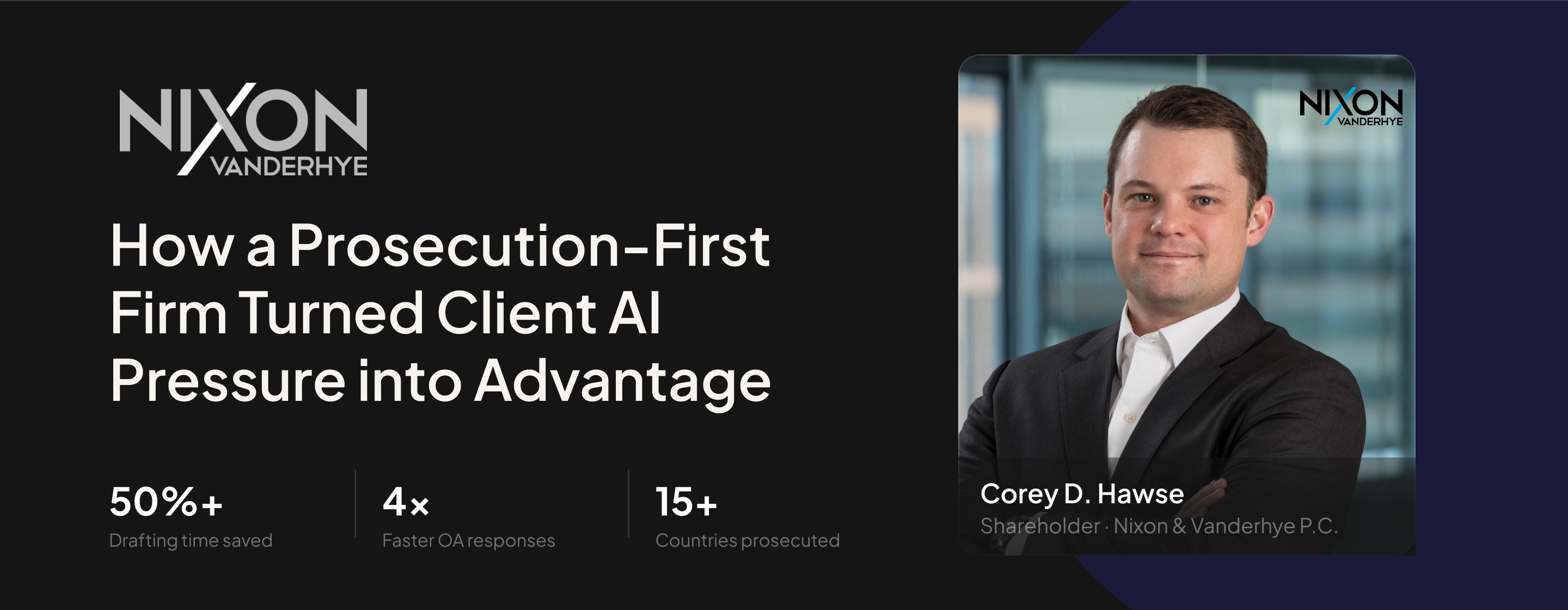
On the tasks where the time savings are sharpest, Hawse estimates productivity gains of 50% or more. When a patent application has 200 pages of drawings, the cumulative effect can be material. That time can then return directly to higher-value work in patent drafting including claim strategy, anticipating examiner objections, and honing the specification for a worldwide portfolio.
Hawse actively encourages clients to submit more thorough invention disclosures up front, knowing that richer input produces more complete output at every stage of drafting with DeepIP. It's a shift in how he manages the client relationship, not just the drafting workflow.
As that habit takes hold across his docket, the gains compound. Better disclosures mean faster drafting, more complete specifications from the first pass—and, notably, less back and forth with inventors, which means less time spent filling gaps that a thorough disclosure would have covered.