Inside the AI-Enabled Patent Office
%20(1).png)

The AI-Enabled Patent Office – What the USPTO’s AI Strategy Means for High-Volume Prosecution
Everyone has an opinion about AI. Far fewer people can say what the USPTO is actually doing with it right now.
On July 28, DeepIP sponsored a live panel on exactly that question, moderated by Gene Quinn (founder of IPWatchdog) with Robert Stoll (former USPTO Commissioner for Patents, now President of Stoll Patent Consulting), Bernard Tomsa (partner at Brooks Cushman), and FX Leduc (CEO of DeepIP). The conversation moved from what's happening inside the Office today to what firms need to be doing about it before the next 12 to 18 months force the issue.
What the Office is already doing
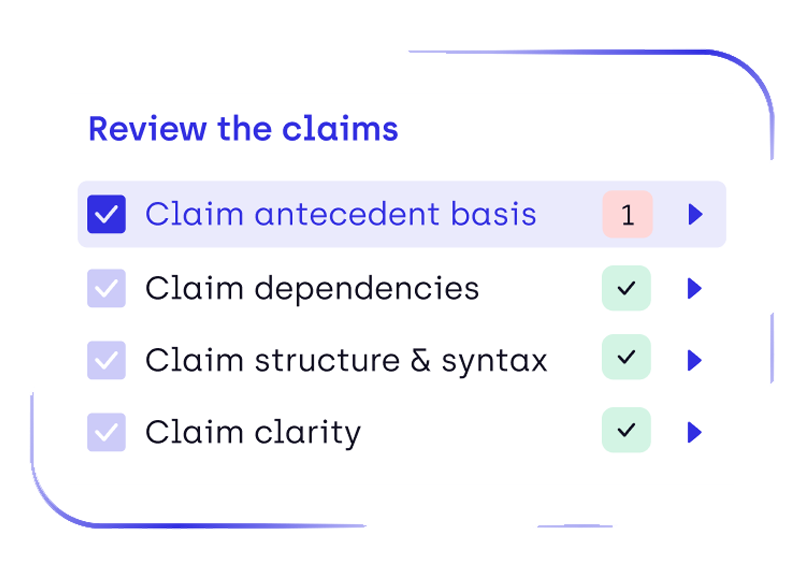
The US Patent Office quietly rolled out an internal AI system to Supervisory Patent Examiners in the fourth quarter of last year, and it's already touching a wide range of tasks: claim construction, summaries of invention, priority-data hygiene, prior-art mapping under Section 102, combination analysis under 103, step-by-step eligibility analysis under 101, clarity and support review under 112, plus a separate tool for classification and image search.
Some of that is uncontroversial. Fact-based, well-bounded work — mapping references, checking priority dates, reviewing clarity — is where the panel agreed AI genuinely helps. The concern starts with the judgment-heavy work: 103 combinations and 101 eligibility, where there's no clean right answer to check against. Once a tool tells an examiner "this is a 103," it tends to become the starting assumption rather than one input among several — closer to gospel than to a suggestion.
Why speed without guardrails is the real risk
The panel kept coming back to one idea: bad guidance is at least a known, fixable problem. You can point to the language, show where it breaks down, and get it revised. An AI model quietly shaping thousands of examiners' calls doesn't leave that kind of trail — nobody can say for certain how much of a flawed office action came from the examiner and how much came from the tool.
There's also a incentive problem. Rejections have historically carried a cost for the examiner — more work, more searching, more scrutiny. If AI removes that friction, what stops the cycle of rejection after rejection? And if the Office ever adopts a rule that examiners must justify disagreeing with the AI, the tool stops being an assistant and starts being the decision-maker by default — the same dynamic many firms already see with internal quality metrics.
That's why the panel's strongest consensus point was procedural, not technical: this should be rolled out as an opt-in pilot, tested against known outcomes, not switched on across the board. As Bernard Tomsa put it, bluntly:
"If AI makes it a costless enterprise to continue rejections, what puts the brakes on that?"
With 1.2 million applications pending, the temptation to lean on AI to simply clear the backlog faster is obvious — and also where the stakes are highest. A patent isn't a renewable right. A bad decision made in the name of speed can't be undone later once the process improves; the panel pointed to the early, inconsistent years of Section 101 case law as a preview of exactly that damage.
The suggested guardrail: back-test any model against thousands of already-decided cases to confirm it reproduces known-good outcomes before trusting it on new ones, and give examiners a small set of standardized, tested prompts rather than open-ended access — otherwise, each examiner's personal AI risks simply mirroring that examiner's own bias back at them. One panelist floated a further fix: expedited review panels, staffed in part by former MPEP authors, to resolve contested AI-driven decisions and write the guidelines as the Office learns.
Not all "AI" is the same tool
A useful distinction from the panel: generative AI — the ChatGPT-style tools most people picture — is non-deterministic, meaning the same question can get different answers on different runs. That's a real problem for something as consequential as patent examination. But it isn't the only kind of AI available. Models trained on a defined ground truth — DeepIP's own approach trains on PTAB decisions to flag Section 101 risk, for instance — are deterministic and far easier to validate at scale.
The framing that tied it together: the goal isn't to delegate judgment to AI, it's to delegate specific, checkable actions while a human still verifies the outcome. That's largely how the Office already uses AI in search — broadening keyword sets, clarifying term definitions — while leaving the relevance call to the examiner. One caveat the panel flagged: training on PTAB decisions is only as good as the decisions themselves, since a decision existing doesn't mean it was well-reasoned. That's a data-curation problem, not just a modeling one.
Prosecution strategy will have to adapt
If examiners start relying on AI-drafted office actions, attorneys may need to change how they argue. Today's playbook is often to keep responses narrow — flag the specific error, avoid over-arguing, keep estoppel risk low — because a human examiner who's shown to be wrong on a point usually won't come back citing the same reference on a different page.
An AI-assisted examiner might not behave that way. Point out that a cited teaching isn't actually on the page referenced, and the tool may simply relocate the citation and reissue the same rejection with a different page number — an endless loop of minor corrections rather than a resolved argument. The likely response from practitioners: lay out the full case earlier and more completely, accepting a bit more estoppel risk in exchange for actually closing out a reference for good.
There's also a framing problem familiar to any litigator: how a question is phrased changes the answer, whether it comes from a person, a jury, or a model. One idea floated for the longer term — not a near-term prediction — was a more interview-like prosecution process, where attorney, examiner, and AI work through open issues together in real time instead of trading sequential written rounds.
Raising the floor, not replacing the ceiling
The clearest framework to come out of the hour: AI should raise the floor on routine, well-understood tasks so human attention concentrates on the genuinely hard margin. The risk is the Office setting that floor too high — automating judgment calls it isn't ready to automate. Fact-based determinations, like Rule 132 declarations, are a comfortable place to start. Section 101 is not, because the underlying case law itself is inconsistent — there's no clean ground truth for a model to learn from. As Bernard Tomsa summed it up: if humans can't agree on the answer, the computer can't either.
Where this leaves practitioners
A live poll during the session found the audience split roughly 30% evaluating AI tools, 30% actively using them, 25% scaling usage, and a shrinking minority not yet started — leadership on adoption skewed toward firm executive teams and individual attorneys, with practice groups somewhat behind.
The bigger picture: prosecution cycles running 24 months today could plausibly compress toward six months within a couple of years as the Office scales its own AI usage. Firms and corporate IP teams that don't adopt comparable tools risk falling behind — not because the tools are optional, but because the other side of the table won't be operating at the old pace anymore.
Why practitioners need equivalent tools now
The thread running under all of this: the Patent Office is not waiting for the industry to catch up. It's already examining applications with AI-assisted claim construction, mapping, and eligibility analysis in the loop. Firms and corporate IP teams that keep working the old way aren't just slower — they're negotiating with an examiner who has tools they don't, on cases where the margin for error keeps shrinking.
Matching that isn't about adopting AI for its own sake. It's about having the same kind of evidence the Office does before it does: a defensible read on Section 101 risk before you file, not after an examiner's tool flags it; a consistent way to check claim language and prior art at the volume a real portfolio requires; and the time back to actually do the strategic work — talking through options with a client, deciding what to argue and what to concede — instead of spending it on the mechanical parts of prosecution.
That's the gap DeepIP is built to close. It runs on deterministic models trained on real PTAB outcomes, not open-ended generative guesswork, so the same input produces the same answer every time — and that training data is reviewed by practitioners, not left to whatever the Office happens to publish. The result is a tool built for exactly the kind of high-stakes, judgment-adjacent work this panel spent an hour worrying about getting wrong: fast enough to keep pace with an accelerating Office, and controlled enough to trust with an outcome you can't undo.
Book a demo to see how DeepIP helps firms and corporate IP teams stay equipped as prosecution timelines compress.
Key takeaways
- The USPTO is already using AI in production, not just piloting it — covering claim construction, priority checks, 102/103 mapping, 101 analysis, 112 review, and classification/search.
- Fact-based tasks are a safe use case; judgment-heavy tasks (101, 103) are not — yet. Once a tool's output reaches an examiner, it tends to harden into an assumption rather than stay a suggestion.
- Speed without validation is the biggest risk to the current backlog of 1.2 million applications. Unlike guidance, a bad AI-influenced decision on an individual patent can't be corrected after the fact.
- Back-testing against known outcomes and standardized prompts are the proposed guardrails — to keep results consistent across examiners and prevent bias from getting baked into individual "personal" AIs.
- Not all AI is equally risky. Deterministic models trained on a defined ground truth (like PTAB decisions) are easier to validate than open-ended generative tools — but only if the underlying training data is curated by humans who understand the law.
- Prosecution strategy will need to adapt as AI-assisted office actions behave differently than human ones — likely pushing attorneys toward more complete, upfront arguments rather than narrow, iterative pushback.
- The floor is rising, not the ceiling — the winning approach lets AI absorb routine work so human judgment concentrates on the hardest, most consequential calls.
- Adoption is already well underway on the outside too: roughly 60% of the audience is already running or scaling AI tools, and firms that don't keep pace risk falling behind as the PTO itself accelerates.
.png)